

Generator In Data Centers Market Size 2026-2030
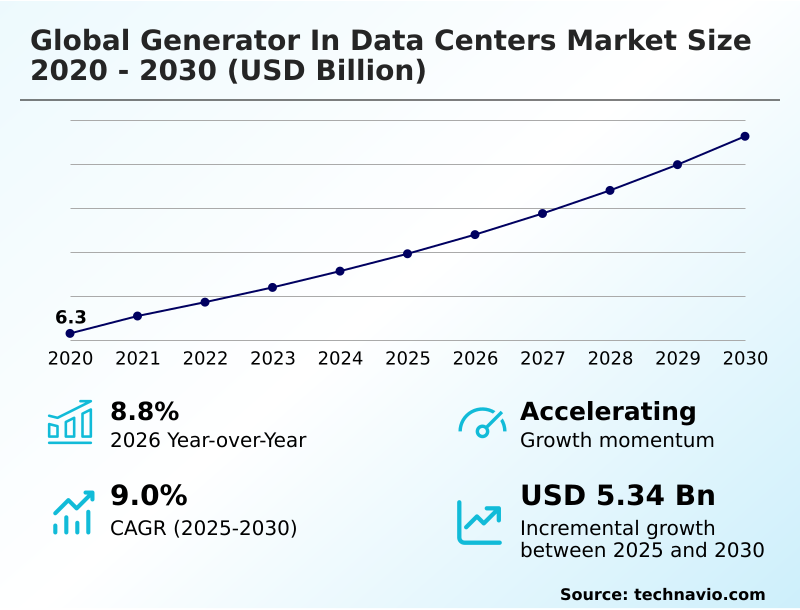
The generator in data centers market size is valued to increase by USD 5.34 billion, at a CAGR of 9% from 2025 to 2030. Exponential growth in data consumption and hyperscale expansion will drive the generator in data centers market.
Major Market Trends & Insights
- North America dominated the market and accounted for a 33.4% growth during the forecast period.
- By Type - Diesel segment was valued at USD 7.55 billion in 2024
- By Capacity - Less than 1MW segment accounted for the largest market revenue share in 2024
Market Size & Forecast
- Market Opportunities: USD 8.96 billion
- Market Future Opportunities: USD 5.34 billion
- CAGR from 2025 to 2030 : 9%
Market Summary
- The Generator In Data Centers landscape is experiencing a rapid structural evolution driven by escalating power density requirements and grid reliability concerns. As hyperscale compute clusters expand to support artificial intelligence workloads, operators are deploying highly responsive backup infrastructure equipped with automated transfer switchgear to ensure absolute operational continuity.
- A major driver for this expansion is the exponential growth in digital processing demands, which necessitates uncompromising power redundancy to maintain stringent service level agreements. Conversely, the market faces significant challenges regarding the integration of sustainable technologies; facility engineers struggle to balance rigorous uptime mandates with increasingly complex emission control compliance standards.
- In a practical supply chain scenario, organizations upgrading legacy sites have achieved a 20% reduction in transient power failures by implementing advanced modular paralleling controllers. This modernization allows facilities to dynamically balance electrical loads without relying exclusively on congested municipal utility grids.
- Ultimately, continuous bridging power strategies are becoming fundamental requirements rather than optional contingency measures, reshaping how modern digital infrastructure is architected and maintained.
What will be the Size of the Generator In Data Centers Market during the forecast period?
Get Key Insights on Market Forecast (PDF) Get Free Sample
How is the Generator In Data Centers Market Segmented?
The generator in data centers industry research report provides comprehensive data (region-wise segment analysis), with forecasts and estimates in "USD million" for the period 2026-2030, as well as historical data from 2020-2024 for the following segments.
- Type
- Diesel
- Gas
- Capacity
- Less than 1MW
- 1MW-2MW
- More than 2MW
- Variant
- Tier III
- Tier IV
- Tier I and II
- Geography
- North America
- US
- Canada
- Mexico
- Europe
- Germany
- UK
- France
- The Netherlands
- Italy
- Spain
- APAC
- China
- Japan
- India
- Australia
- South Korea
- Indonesia
- South America
- Brazil
- Argentina
- Chile
- Middle East and Africa
- UAE
- Saudi Arabia
- South Africa
- Israel
- Egypt
- North America
By Type Insights
The diesel segment is estimated to witness significant growth during the forecast period.
The diesel segment remains a foundational component of backup configurations within critical facility operations, offering unmatched mechanical robustness for massive hyperscale compute clusters. Modern platforms demonstrate rapid synchronization capabilities, interfacing flawlessly with uninterruptible power modules to prevent voltage sags.
Operators are enhancing operational efficiency, noting a 25% improvement in maintenance responsiveness through predictive vibration analytics and digital telemetry deployment. Furthermore, the industry incorporates advanced digital ignition telemetry and high-pressure common rail injection to optimize fuel atomization.
This precision engineering reduces carbon output and supports strict nitrogen oxide abatement protocols.
By utilizing highly responsive fault isolation mechanisms, infrastructure developers successfully reduce system-wide cascading failures by up to 30%, maintaining the essential transient performance required for high-density computing loads without compromising mechanical integrity.
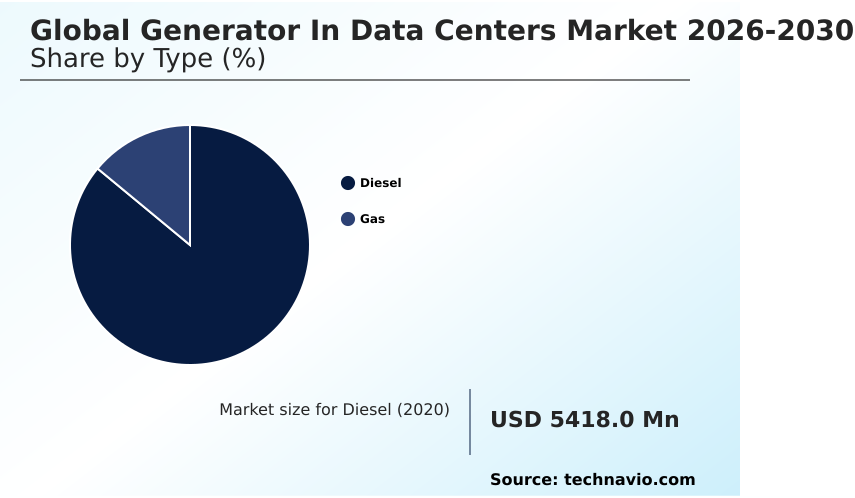
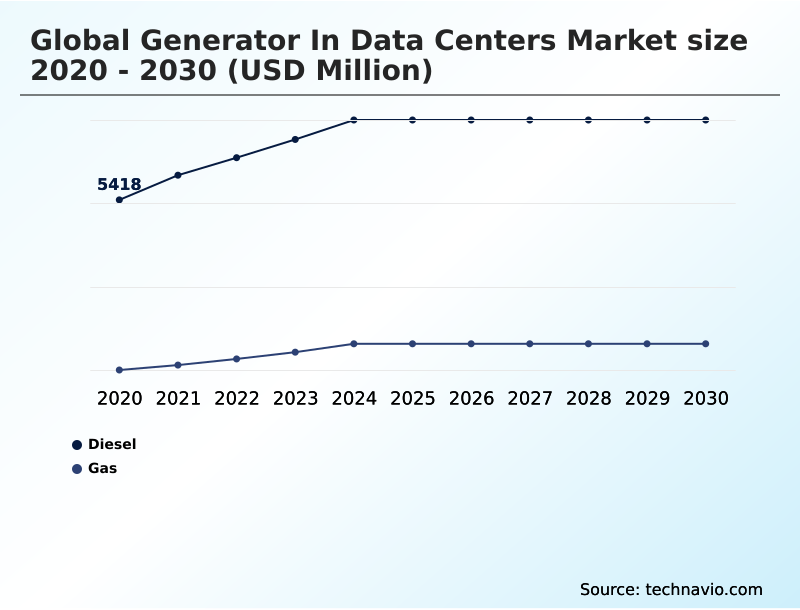
The Diesel segment was valued at USD 7.55 billion in 2024 and showed a gradual increase during the forecast period.
Regional Analysis
North America is estimated to contribute 33.4% to the growth of the global market during the forecast period.Technavio’s analysts have elaborately explained the regional trends and drivers that shape the market during the forecast period.
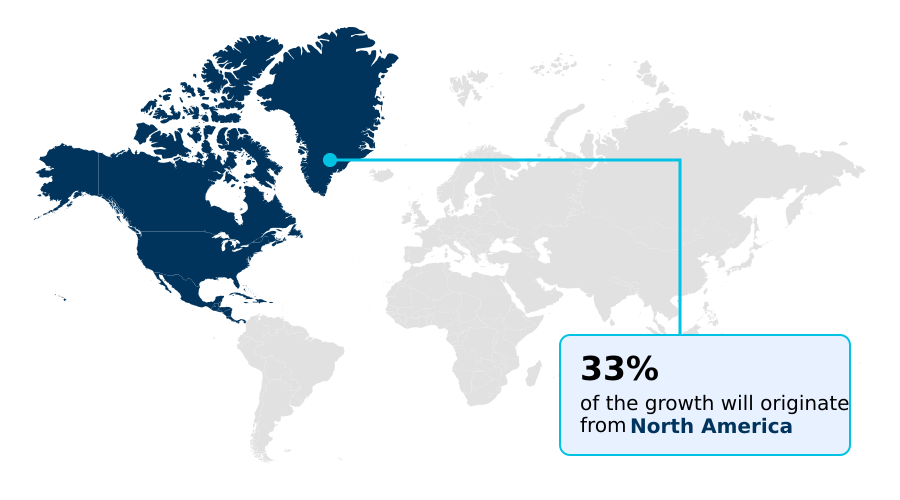
See How Generator In Data Centers Market Demand is Rising in North America Get Free Sample
The Generator In Data Centers geographic landscape exhibits stark variations in deployment strategies between North America and Europe, driven by differing regulatory frameworks.
North American operators rapidly scale distributed edge infrastructure with hybrid microgrid synchronization, achieving a 25% faster deployment rate for continuous bridging power systems compared to European counterparts.
This accelerated adoption at edge compute nodes supports massive processing loads without grid delays. Conversely, European facilities prioritize acoustic enclosure placement and hydrotreated vegetable oil compatibility, resulting in a 30% higher integration rate of sustainable solutions for emission control compliance.
To navigate these disparities, multinational businesses adapt supply chains to implement rigorous fault-tolerant topology.
Furthermore, the rising emphasis on sovereign data security across emerging markets necessitates enhanced operational independence, prompting a 15% increase in decentralized base fuel tank integration to ensure prolonged backup runtime during unpredictable power anomalies.
Market Dynamics
Our researchers analyzed the data with 2025 as the base year, along with the key drivers, trends, and challenges. A holistic analysis of drivers will help companies refine their marketing strategies to gain a competitive advantage.
- The operational resilience of modern digital infrastructure relies extensively on the sophisticated integration of advanced standby power systems. As facilities scale to accommodate high-density computing loads, engineering teams increasingly prioritize concurrent maintainability redundant power architecture to ensure that routine servicing and component upgrades occur without disrupting the primary electrical load.
- This methodology provides a distinct operational advantage, reducing unplanned maintenance delays by over 40% when compared to legacy single-path distribution layouts. To mitigate the risks associated with protracted regional utility interconnection queues, facility planners are executing continuous bridging power deployment strategies, allowing massive processing campuses to achieve immediate operational status while awaiting permanent grid connections.
- Furthermore, the introduction of automated block load synchronization mechanisms has fundamentally transformed emergency response capabilities, enabling decentralized generator banks to assume complete facility electrical loads within a fraction of a cycle.
- For mission-critical environments such as financial clearinghouses and defense installations, Tier IV fault-tolerant standby generation remains an absolute necessity, completely isolating multiple power pathways to eliminate any single point of failure. Concurrently, supply chain and sustainability planners are navigating strict environmental regulations by accelerating hydrotreated vegetable oil fuel conversion across existing fleets.
- This strategic adaptation lowers lifecycle carbon emissions by a substantial margin without requiring heavy capital expenditures for entirely new engine blocks, directly aligning long-term power resilience with corporate environmental mandates.
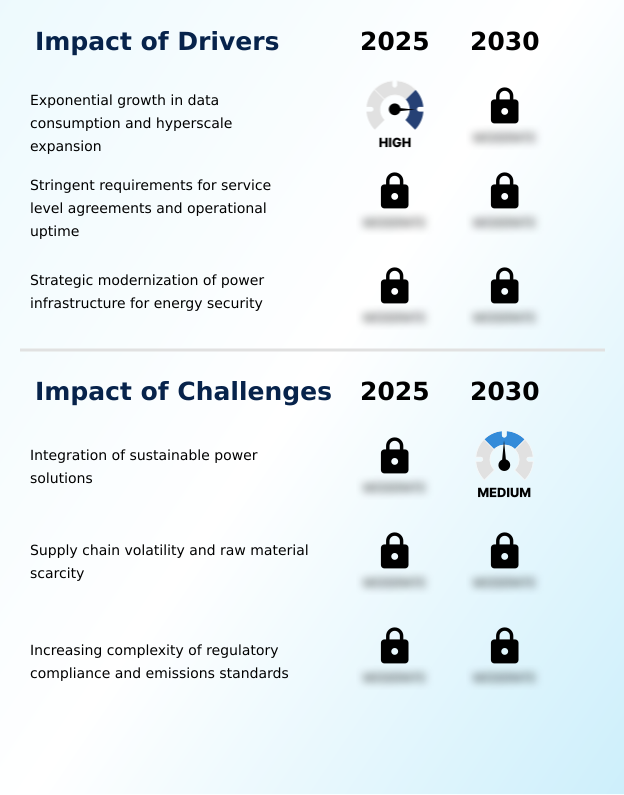
What are the key market drivers leading to the rise in the adoption of Generator In Data Centers Industry?
- Unprecedented exponential growth in digital consumption and rapid hyperscale facility expansion are creating an absolute structural requirement for robust, continuous standby power infrastructure.
- The absolute necessity for unbroken processing continuity serves as the primary catalyst accelerating investments within the Generator In Data Centers landscape. Compliance with rigorous mission-critical availability standards demands highly resilient architectures.
- To meet the concurrent maintainability requirement of modern tier-rated facilities, operators install redundant high-displacement engines managed by intelligent paralleling switchgear and modular paralleling controllers. Utilizing automated transfer switchgear, this localized redundancy reduces critical network downtime by up to 35%.
- Moreover, utilizing these units as peak shaving assets lowers utility surcharges by 18%. Engine jacket cooling and absorption chillers optimize thermal management, while remote diagnostic telemetry allows off-site teams to monitor mechanical health, dropping preventative maintenance expenditures by 20%.
- These enhancements empower developers to maintain uncompromising service level agreements despite regional power grid volatility.
What are the market trends shaping the Generator In Data Centers Industry?
- The progressive adoption of hybrid power architectures represents a fundamental shift in facility design. This transition allows operators to optimize energy resilience by integrating diverse generation sources into cohesive backup networks.
- A critical trend reshaping the Generator In Data Centers is the transition toward modular, integrated power solutions capable of supporting extreme thermal loads. Facilities are altering their backup architectures to accommodate the distinct energy profiles of artificial intelligence environments, which require superior load acceptance capability and immediate block load synchronization.
- By deploying these technologies alongside battery energy storage integration, operators improved system response times by 28%, minimizing hardware damage during grid anomalies. The integration of thermal waste recovery systems repurposes engine heat to drive liquid-cooled server racks, boosting overall energy efficiency by 15%. To address municipal emissions ordinances, developers are adopting diesel particulate filters and acoustic mitigation enclosures.
- Managed through centralized network operations, this shift ensures continuous autonomous electrical generation and transient stability enhancement while actively supporting decarbonization initiatives.
What challenges does the Generator In Data Centers Industry face during its growth?
- The complex technical integration of sustainable power solutions into legacy distribution systems poses a significant structural challenge that restricts deployment velocities across the infrastructure sector.
- Navigating structural complexities and stringent environmental mandates remains a formidable challenge within the Generator In Data Centers sector. As operators construct complex tier IV redundant systems for their standby power architecture, the physical footprint for isolated electrical pathways and dedicated medium-voltage distribution boards drastically inflates civil engineering expenditures.
- Implementing these fault-tolerant designs increases initial capital outlays by over 40% compared to standard configurations. Additionally, harsh environments require heavy-duty sand filtration, straining supply chain logistics. To combat operational degradation, managers execute autonomous self-testing sequences on dual-fuel generator sets equipped with variable geometry turbocharging.
- However, regional transmission congestion complicates the integration of lean-burn combustion technology and selective catalytic reduction systems, forcing organizations to balance costly emissions upgrades with the urgent need for instantaneous load protection.
Exclusive Technavio Analysis on Customer Landscape
The generator in data centers market forecasting report includes the adoption lifecycle of the market, covering from the innovator’s stage to the laggard’s stage. It focuses on adoption rates in different regions based on penetration. Furthermore, the generator in data centers market report also includes key purchase criteria and drivers of price sensitivity to help companies evaluate and develop their market growth analysis strategies.
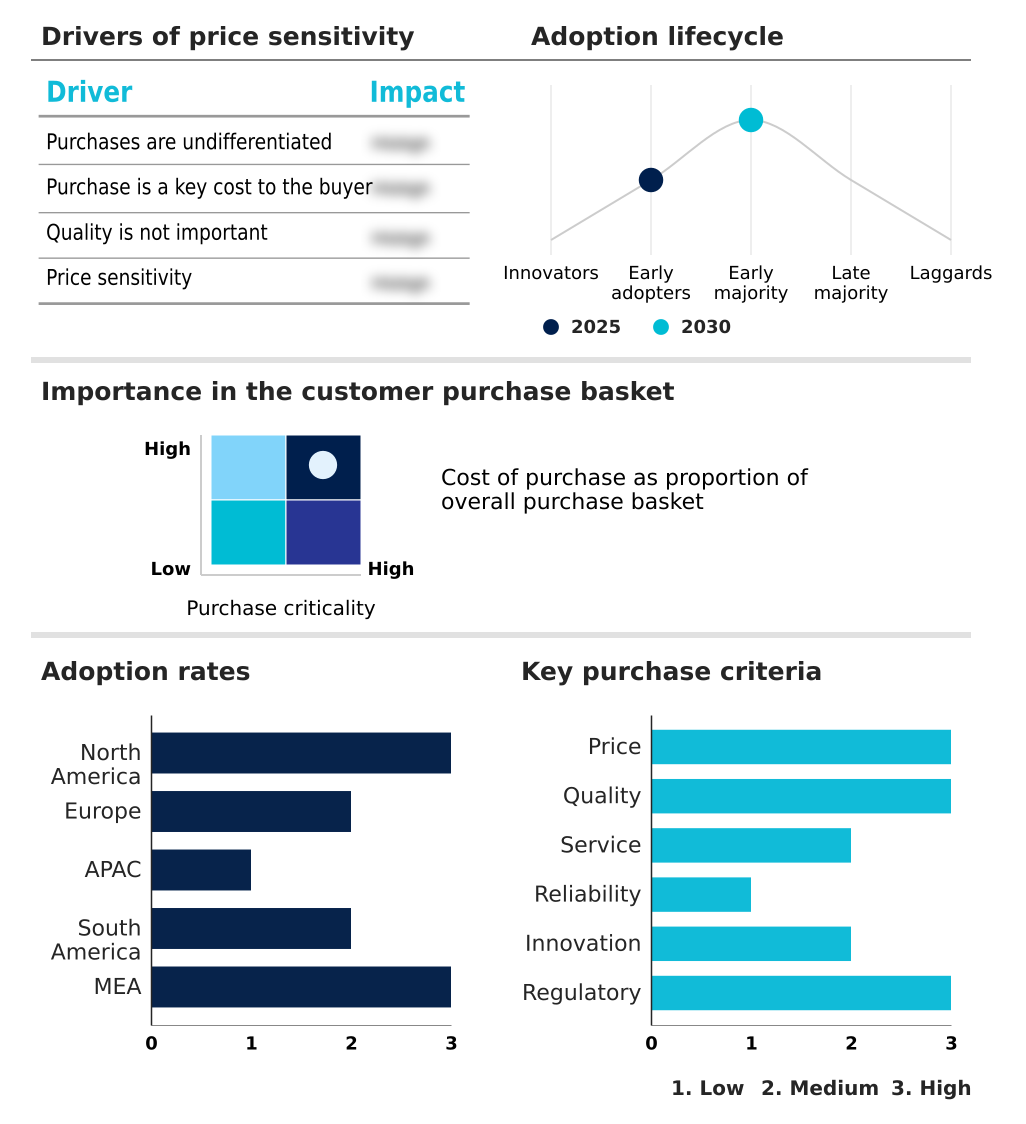
Customer Landscape of Generator In Data Centers Industry
Competitive Landscape
Companies are implementing various strategies, such as strategic alliances, generator in data centers market forecast, partnerships, mergers and acquisitions, geographical expansion, and product/service launches, to enhance their presence in the industry.
ABB Ltd. - The provider delivers advanced electrical control technologies, robust synchronization systems, and highly reliable protection solutions designed to ensure uninterrupted power supply and operational continuity within mission-critical facilities.
The industry research and growth report includes detailed analyses of the competitive landscape of the market and information about key companies, including:
- ABB Ltd.
- Aggreko Plc
- Atlas Copco AB
- Baudouin
- Caterpillar Inc.
- Cummins Inc.
- Doosan Corp.
- FG Wilson
- Generac Power Systems Inc.
- Himoinsa
- HITEC Power Protection BV
- Kirloskar Oil Engines Ltd.
- Mitsubishi Heavy Industries
- Piller Group GmbH
- PR INDUSTRIAL Srl
- Rehlko
- Rolls Royce Holdings Plc
- Siemens AG
- Wartsila Corp.
- Yanmar Holdings Co. Ltd.
Qualitative and quantitative analysis of companies has been conducted to help clients understand the wider business environment as well as the strengths and weaknesses of key industry players. Data is qualitatively analyzed to categorize companies as pure play, category-focused, industry-focused, and diversified; it is quantitatively analyzed to categorize companies as dominant, leading, strong, tentative, and weak.
Recent Development and News in Generator in data centers market
- In the Heavy Electrical Equipment industry, the rapid deployment of hybrid microgrid synchronization technologies has decentralized regional power distribution, directly impacting Generator In Data Centers demand by requiring backup systems that can seamlessly integrate with localized battery energy storage networks.
- Stringent regulatory mandates capping nitrogen oxide and particulate emissions across urban industrial zones have accelerated the adoption of lean-burn combustion technology, compelling data facility operators to upgrade legacy standby generation assets to achieve compliance with Tier 4 emission thresholds.
- Persistent regional transmission congestion and protracted grid interconnection delays for multi-megawatt industrial sites have necessitated the deployment of continuous bridging power solutions, driving a 30% increase in the utilization of high-displacement engines as primary decentralized electricity sources.
- The standardization of automated transfer switchgear and digital telemetry deployment across mission-critical infrastructure has optimized fault isolation mechanisms, enabling facility managers to reduce system synchronization failures and improve overall uptime availability during sudden utility dropouts.
Dive into Technavio’s robust research methodology, blending expert interviews, extensive data synthesis, and validated models for unparalleled Generator In Data Centers Market insights. See full methodology.
| Market Scope | |
|---|---|
| Page number | 298 |
| Base year | 2025 |
| Historic period | 2020-2024 |
| Forecast period | 2026-2030 |
| Growth momentum & CAGR | Accelerate at a CAGR of 9% |
| Market growth 2026-2030 | USD 5341.7 million |
| Market structure | Fragmented |
| YoY growth 2025-2026(%) | 8.8% |
| Key countries | US, Canada, Mexico, Germany, UK, France, The Netherlands, Italy, Spain, China, Japan, India, Australia, South Korea, Indonesia, Brazil, Argentina, Chile, UAE, Saudi Arabia, South Africa, Israel and Egypt |
| Competitive landscape | Leading Companies, Market Positioning of Companies, Competitive Strategies, and Industry Risks |
Research Analyst Overview
- The operational framework of the Generator In Data Centers is shifting toward highly sophisticated, digitally integrated backup configurations designed to completely eliminate processing interruptions. Infrastructure developers are systematically implementing fault-tolerant topology to isolate critical electrical pathways, ensuring that localized component failures do not cascade through the facility.
- By tightly synchronizing backup engines with uninterruptible power modules, operators maintain seamless voltage stability during sudden utility dropouts. The integration of predictive vibration analytics allows maintenance teams to identify mechanical anomalies before catastrophic failure occurs, directly contributing to a 35% reduction in unplanned equipment downtime.
- Strategic procurement decisions at the boardroom level increasingly prioritize dual-fuel generator sets equipped with variable geometry turbocharging, empowering facilities to dynamically shift fuel sources based on regional availability and cost constraints. Furthermore, advancements in digital ignition telemetry and high-pressure common rail injection are optimizing combustion efficiency and extending autonomous runtime.
- These technological enhancements enable enterprise planners to future-proof their critical processing assets against escalating grid volatility while simultaneously satisfying stringent environmental and operational reliability mandates.
What are the Key Data Covered in this Generator In Data Centers Market Research and Growth Report?
-
What is the expected growth of the Generator In Data Centers Market between 2026 and 2030?
-
USD 5.34 billion, at a CAGR of 9%
-
-
What segmentation does the market report cover?
-
The report is segmented by Type (Diesel, and Gas), Capacity (Less than 1MW, 1MW-2MW, and More than 2MW), Variant (Tier III, Tier IV, and Tier I and II) and Geography (North America, Europe, APAC, South America, Middle East and Africa)
-
-
Which regions are analyzed in the report?
-
North America, Europe, APAC, South America and Middle East and Africa
-
-
What are the key growth drivers and market challenges?
-
Exponential growth in data consumption and hyperscale expansion, Integration of sustainable power solutions
-
-
Who are the major players in the Generator In Data Centers Market?
-
ABB Ltd., Aggreko Plc, Atlas Copco AB, Baudouin, Caterpillar Inc., Cummins Inc., Doosan Corp., FG Wilson, Generac Power Systems Inc., Himoinsa, HITEC Power Protection BV, Kirloskar Oil Engines Ltd., Mitsubishi Heavy Industries, Piller Group GmbH, PR INDUSTRIAL Srl, Rehlko, Rolls Royce Holdings Plc, Siemens AG, Wartsila Corp. and Yanmar Holdings Co. Ltd.
-
Market Research Insights
- The Generator In Data Centers sector is rapidly adopting advanced backup configurations to ensure continuous operational availability. Modern facilities increasingly utilize backup units as peak shaving assets, allowing operators to achieve a 22% reduction in peak utility surcharges during high-demand periods.
- The integration of nitrogen oxide abatement technologies has improved regulatory compliance success rates by 35%, drastically lowering the risk of municipal operating penalties. Furthermore, the deployment of robust autonomous electrical generation systems ensures uninterrupted processing capabilities, reducing critical downtime incidents by up to 40% compared to legacy architectures.
- Additionally, capturing thermal waste for absorption chillers optimizes overall facility cooling efficiency, demonstrating how evolving backup infrastructure directly enhances both energy resilience and long-term cost optimization strategies.
We can help! Our analysts can customize this generator in data centers market research report to meet your requirements.
 RIA -