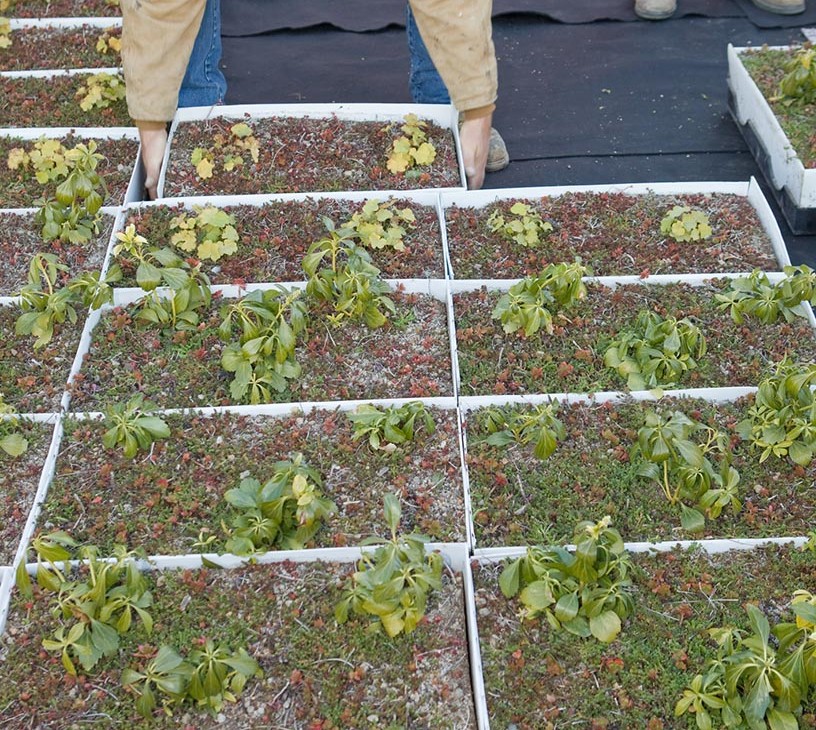
Green-roofs Market Analysis, Size, and Forecast 2026-2030: North America (US, Canada, and Mexico), Europe (Germany, UK, and France), APAC (China, Japan, and India), South America (Brazil, Argentina, and Chile), Middle East and Africa (Saudi Arabia, UAE, and South Africa), and Rest of World (ROW)

Green-roofs Market Analysis, Size, and Forecast 2026-2030:
North America (US, Canada, and Mexico), Europe (Germany, UK, and France), APAC (China, Japan, and India), South America (Brazil, Argentina, and Chile), Middle East and Africa (Saudi Arabia, UAE, and South Africa), and Rest of World (ROW)

Published: Oct 2026 292 Pages SKU: IRTNTR44393

Market Overview at a Glance

$9.64 B
Market Opportunity
11.3%
CAGR 2025 - 2030
33.5%
North America Growth
$7.87 B
Residential segment 2024

Green-Roofs Market Size 2026-2030

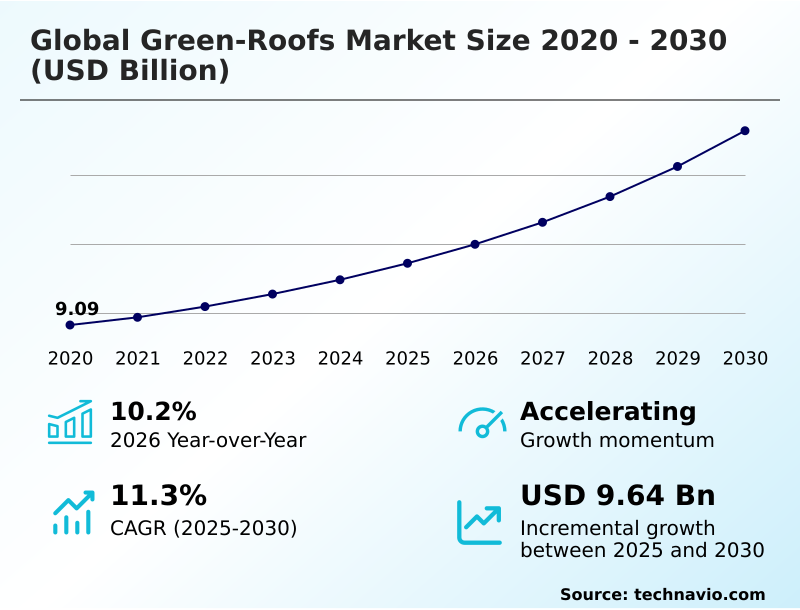
The green-roofs market size is valued to increase by USD 9.64 billion, at a CAGR of 11.3% from 2025 to 2030. Strict municipal stormwater regulations and financial greening incentives will drive the green-roofs market.

Major Market Trends & Insights

  • North America dominated the market and accounted for a 33.5% growth during the forecast period.
  • By Application - Residential segment was valued at USD 7.87 billion in 2024
  • By Product - Extensive segment accounted for the largest market revenue share in 2024

Market Size & Forecast

  • Market Opportunities: USD 14.13 billion
  • Market Future Opportunities: USD 9.64 billion
  • CAGR from 2025 to 2030 : 11.3%

Market Summary

  • The Green-roofs operates as a critical environmental infrastructure segment driven by the escalating necessity for sustainable urban water management and thermal regulation. Commercial real estate developers systematically deploy monolithic waterproofing membranes combined with advanced drainage and filter systems to transform conventional rooftops into high-performance ecological assets.
  • In a practical supply chain scenario, logistics centers integrating these vegetative systems protect sensitive indoor inventory from extreme temperature fluctuations, effectively reducing mechanical cooling demands by 22% compared to traditional dark asphalt roofing.
  • A major driver propelling the Green-roofs is the aggressive implementation of municipal stormwater retention policies, forcing property owners to adopt source-control water management to align with mandatory carbon reduction targets. Conversely, severe structural load weight restrictions present a profound operational challenge, limiting retrofitting capabilities on older industrial properties that cannot safely support saturated soil burdens.
  • These living architectural systems remain essential for achieving rigorous environmental compliance and preserving the long-term integrity of sustainable building envelopes across increasingly dense metropolitan zones.

What will be the Size of the Green-Roofs Market during the forecast period?
Get Key Insights on Market Forecast (PDF) Get Free Sample

How is the Green-Roofs Market Segmented?

The green-roofs industry research report provides comprehensive data (region-wise segment analysis), with forecasts and estimates in "USD million" for the period 2026-2030, as well as historical data from 2020-2024 for the following segments.

  • Application
    • Residential
    • Commercial
    • Industrial
  • Product
    • Extensive
    • Intensive
  • Type
    • Sedum and succulents
    • Native grasses and wildflowers
    • Vegetable and herb gardens
  • Geography
    • North America
      • US
      • Canada
      • Mexico
    • Europe
      • Germany
      • UK
      • France
      • Italy
      • Spain
      • The Netherlands
    • APAC
      • China
      • Japan
      • India
      • South Korea
      • Australia
      • Indonesia
    • South America
      • Brazil
      • Argentina
      • Chile
    • Middle East and Africa
      • Saudi Arabia
      • UAE
      • South Africa
      • Israel
      • Turkey

By Application Insights

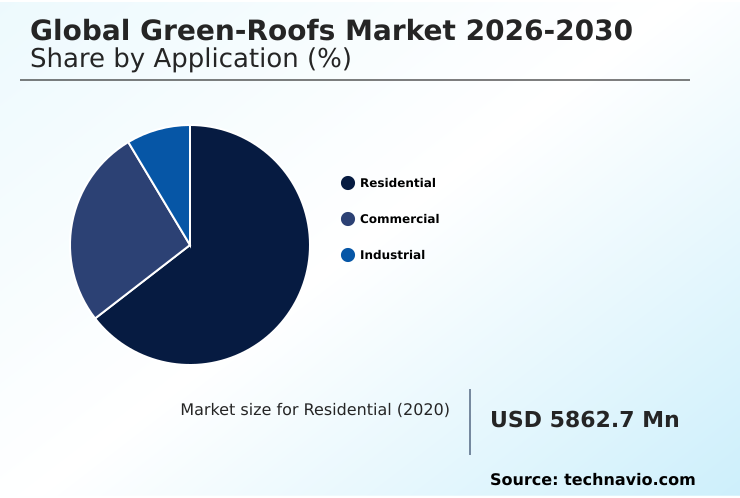
The residential segment is estimated to witness significant growth during the forecast period.

The residential application segment within the green-roofs marketplace demonstrates continuous evolution as urban housing developers prioritize sustainable building envelopes and structural thermal management.

By integrating lightweight growth substrates and extensive vegetative ecosystems directly onto multi-family housing units, property managers significantly enhance building energy efficiency.

This structural adaptation facilitates natural plant evapotranspiration, which provides critical thermal mass insulation and lowers internal residential cooling demands by up to 15% during peak summer months.

Furthermore, the deployment of these vegetative layers actively supports urban flooding mitigation by optimizing stormwater runoff retention, thereby contributing to peak load reduction across aging municipal infrastructures.

Consequently, real estate investors are increasingly leveraging these localized environmental integrations to secure lucrative zoning density bonuses and achieve premium green building certifications for high-density residential portfolios.
Get Free Sample

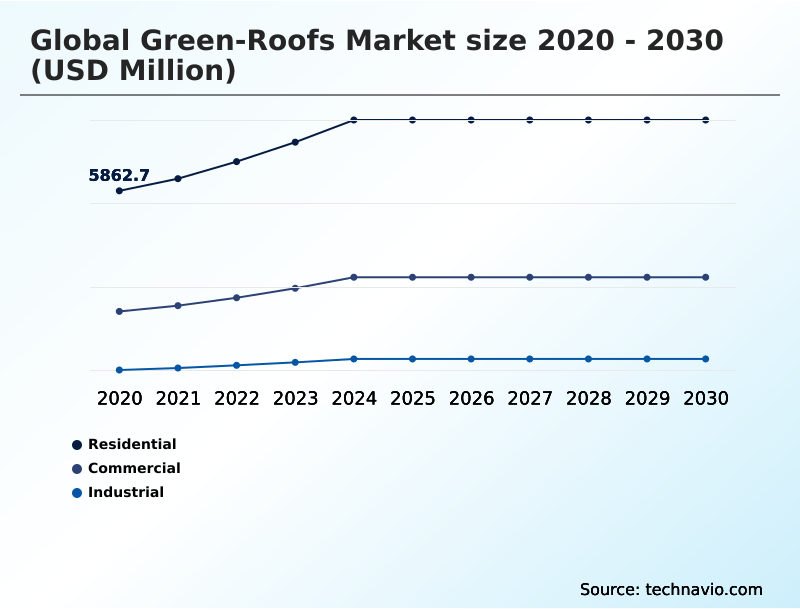
The Residential segment was valued at USD 7.87 billion in 2024 and showed a gradual increase during the forecast period.
Get Free Sample

Regional Analysis

North America is estimated to contribute 33.5% to the growth of the global market during the forecast period.Technavio’s analysts have elaborately explained the regional trends and drivers that shape the market during the forecast period.
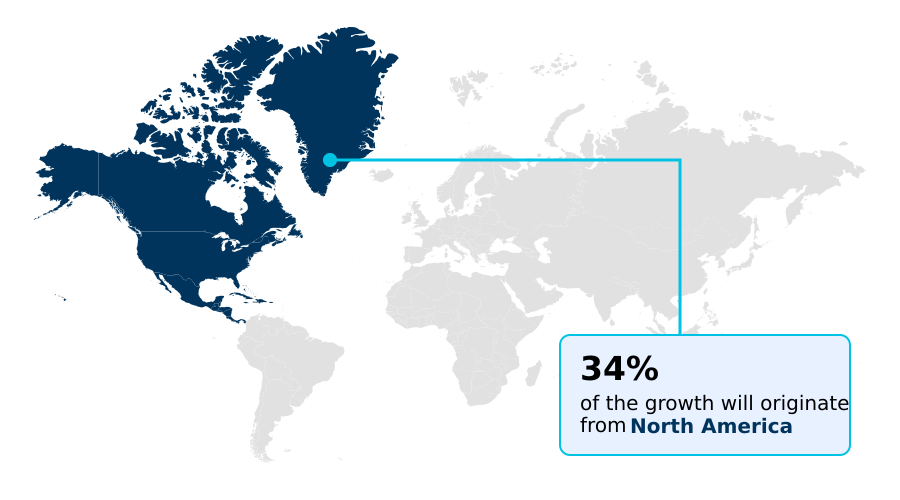
See How Green-Roofs Market Demand is Rising in North America Get Free Sample

The geographic adoption of green-roofs highlights distinct operational strategies driven by varied municipal regulations and localized climatic demands.

The European market relies heavily on strict biodiversity net gain mandates, forcing real estate groups to utilize engineered hyper-lightweight substrates to satisfy structural load weight restrictions on historic buildings.

This regulatory environment has accelerated European compliance efficiency by 25% over developing markets. In contrast, the North American landscape prioritizes rapid installation across vast commercial warehouses, leveraging prefabricated post-consumer recycled plastic cassettes to cut labor deployment times by 18%.

Additionally, regions facing acute water scarcity mandate the integration of automated micro-drip watering cycles to ensure biological survival.

As municipalities worldwide refine their sustainable urban planning, businesses strategically adapt procurement models to prioritize localized horticultural suppliers, effectively minimizing logistics costs while meeting stringent environmental infrastructure requirements.

Market Dynamics

Our researchers analyzed the data with 2025 as the base year, along with the key drivers, trends, and challenges. A holistic analysis of drivers will help companies refine their marketing strategies to gain a competitive advantage.

  • The commercial progression of the green-roofs sector is highly contingent upon advanced engineering methodologies that harmonize urban climate adaptation with stringent corporate operational planning. Facilities management teams are increasingly prioritizing rigorous stormwater runoff retention efficiency rates to alleviate the heavy taxation and compliance burdens associated with municipal water utility grids.
  • By migrating from conventional roofing to living architectural solutions, organizations can effectively bypass standard infrastructure constraints while strengthening broader urban heat island mitigation strategies. To guarantee biological consistency across fluctuating weather cycles, property developers rely on automated smart irrigation network deployment, which continuously monitors moisture levels and prevents costly plant desiccation without requiring manual labor interventions.
  • Furthermore, supply chain architects evaluate lightweight modular tray configuration performance as a critical baseline for expediting large-scale industrial retrofits. This pre-grown, inter-locking approach mitigates the logistical bottlenecks historically caused by hauling bulk soils to high-altitude sites, resulting in a project completion velocity that outpaces traditional built-in-place installations by roughly 40%.
  • Concurrently, energy procurement directors are aggressively pursuing extensive biosolar roof photovoltaic integration. This dual-purpose infrastructure directly enhances localized thermodynamic cooling, allowing surrounding solar panels to operate at maximum efficiency during peak summer stress periods. By systematically leveraging these sophisticated ecological layers, commercial real estate portfolios achieve superior long-term asset protection, lower mechanical cooling expenditures, and secure elite global environmental credentials.
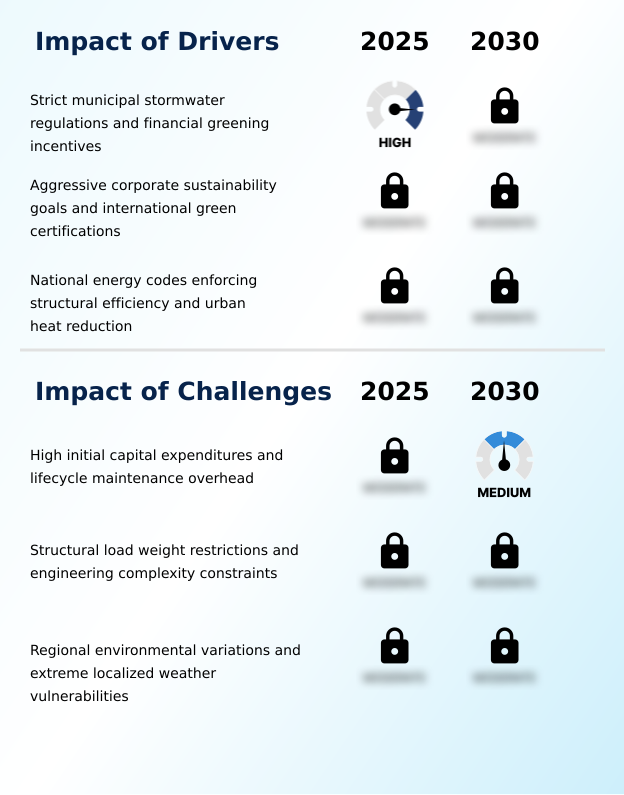
What are the key market drivers leading to the rise in the adoption of Green-Roofs Industry?

  • Strict municipal stormwater regulations, combined with substantial financial greening incentives, serve as the primary catalysts driving market expansion.

  • The aggressive expansion of municipal stormwater management regulations acts as a primary catalyst forcing the widespread commercial procurement of green-roofs.
  • As rapid urbanization accelerates permeable landscape replacement, city infrastructures suffer from catastrophic runoff volumes, prompting authorities to legally mandate high-performance building envelopes on new corporate constructions.
  • This regulatory pressure causes development groups to adopt living roofs, effectively reducing peak stormwater discharge rates by up to 60% and supporting tangible urban air pollution reduction.
  • Furthermore, integrating these vegetative barriers facilitates significant microclimatic stressor reduction, improving internal building energy conversion efficiency by 15%.
  • This structural adaptation allows real estate owners to drastically lower operational cooling expenses while securing lucrative density bonuses, fundamentally transforming sustainable roofing into an economically vital corporate asset.

What are the market trends shaping the Green-Roofs Industry?

  • The technological integration of biosolar roofs with distributed photovoltaic systems represents a definitive industry trend. This advanced structural approach optimizes urban surface space while significantly enhancing overall solar energy generation.

  • The architectural transition toward interconnected sustainable infrastructure is fundamentally altering the deployment standards of the green-roofs sector. Commercial developers are abandoning traditional built-in-place intensive systems in favor of advanced hybrid ecosystems designed to optimize localized power generation.
  • By integrating specialized succulents utilizing crassulacean acid metabolism physiology around solar arrays, facilities can lower the ambient rooftop microclimate temperature, thereby boosting photovoltaic panel efficiency by nearly 8% during extreme summer conditions. This integration acts as a critical cause for modernization, enabling facility managers to maximize clean energy output while simultaneously improving sub-surface drainage efficiency by 20%.
  • Consequently, corporate asset planners benefit from reduced mechanical cooling demands and a lower overall carbon footprint, positioning intelligent biosolar networks as a mandatory requirement for next-generation smart city commercial developments.

What challenges does the Green-Roofs Industry face during its growth?

  • High initial capital expenditures, compounded by ongoing lifecycle maintenance overhead, constitute a primary barrier restricting widespread commercial deployment.

  • The global implementation of green-roofs is significantly hindered by the technical difficulties associated with volatile regional climate shifts and extreme weather events. Designing living architectures to withstand prolonged droughts or sudden monsoon rains causes immense engineering friction, forcing facility managers to prioritize complex substrate waterlogging prevention mechanisms.
  • These localized environmental variations directly threaten long-term vegetative ecosystem survival, increasing unexpected biological replacement costs by over 30% in high-stress urban zones. Consequently, property owners face substantially elevated lifecycle maintenance overhead to continuously monitor and adjust mechanical irrigation and drainage systems.
  • This ongoing financial and operational burden discourages mid-tier developers from investing in advanced multi-layer systems, restricting widespread market penetration to premium real estate portfolios capable of absorbing continuous post-installation upkeep expenditures.

Exclusive Technavio Analysis on Customer Landscape

The green-roofs market forecasting report includes the adoption lifecycle of the market, covering from the innovator’s stage to the laggard’s stage. It focuses on adoption rates in different regions based on penetration. Furthermore, the green-roofs market report also includes key purchase criteria and drivers of price sensitivity to help companies evaluate and develop their market growth analysis strategies.
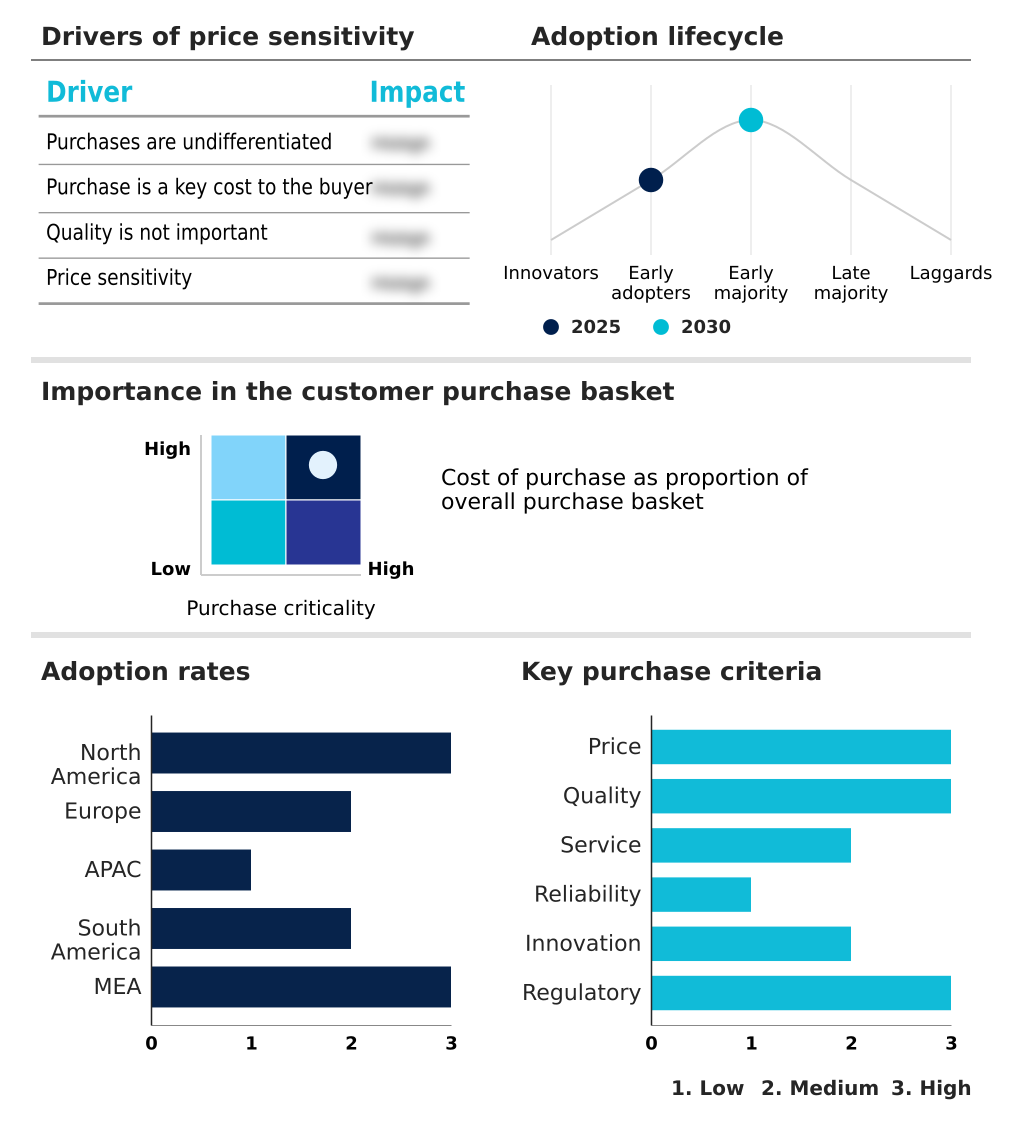
Customer Landscape of Green-Roofs Industry

Competitive Landscape

Companies are implementing various strategies, such as strategic alliances, green-roofs market forecast, partnerships, mergers and acquisitions, geographical expansion, and product/service launches, to enhance their presence in the industry.

Alumasc Roofing Systems - Provides engineered extensive and intensive vegetative roofing systems designed to optimize structural water management, support urban biodiversity, and deliver sustainable building envelope compliance without relying on traditional roofing infrastructure.

The industry research and growth report includes detailed analyses of the competitive landscape of the market and information about key companies, including:

  • Alumasc Roofing Systems
  • BioRoof Systems
  • Carlisle SynTec Systems
  • GAF Materials LLC
  • Green Roof Blocks
  • GREENRISE TECHNOLOGIES
  • GreenTech ITM
  • Henry Co.
  • HydroTech USA
  • IKO Industries Ltd.
  • LiveRoof Global LLC
  • Onduline Group SAS
  • Optigrun international AG
  • Paul Bauder GmbH and Co. KG
  • Sempergreen
  • Sika AG
  • SOPREMA SAS
  • Tajima Roofing Inc.
  • Tremco Roofing
  • ZinCo GmbH

Qualitative and quantitative analysis of companies has been conducted to help clients understand the wider business environment as well as the strengths and weaknesses of key industry players. Data is qualitatively analyzed to categorize companies as pure play, category-focused, industry-focused, and diversified; it is quantitatively analyzed to categorize companies as dominant, leading, strong, tentative, and weak.

Recent Development and News in Green-roofs market

  • In the Building Products industry, the strict enforcement of European environmental directives mandates high-performance building envelopes, directly driving green-roofs demand as commercial developers implement sustainable architectural solutions to reduce structural energy consumption by over 20%.
  • The widespread adoption of recycled polymeric materials for construction drainage and filter systems has lowered raw material procurement costs, allowing green-roofs manufacturers to improve production margins by up to 12% while maintaining stringent environmental compliance.
  • Advancements in automated smart irrigation networks integrated into civil infrastructure management platforms have reduced water consumption in large-scale commercial developments, significantly improving the operational viability and survival rates of extensive vegetative ecosystems by nearly 18%.
  • The integration of distributed photovoltaic solar arrays with structural shade optimization technologies has created hybrid energy roofs, pulling green-roofs demand upward as combined installations boost overall solar energy conversion efficiency by up to 8%.

Dive into Technavio’s robust research methodology, blending expert interviews, extensive data synthesis, and validated models for unparalleled Green-Roofs Market insights. See full methodology.

Market Scope
Page number 292
Base year 2025
Historic period 2020-2024
Forecast period 2026-2030
Growth momentum & CAGR Accelerate at a CAGR of 11.3%
Market growth 2026-2030 USD 9637.8 million
Market structure Fragmented
YoY growth 2025-2026(%) 10.2%
Key countries US, Canada, Mexico, Germany, UK, France, Italy, Spain, The Netherlands, China, Japan, India, South Korea, Australia, Indonesia, Brazil, Argentina, Chile, Saudi Arabia, UAE, South Africa, Israel and Turkey
Competitive landscape Leading Companies, Market Positioning of Companies, Competitive Strategies, and Industry Risks

Request Free Sample

Research Analyst Overview

  • Strategic capital investments within the green-roofs sector are fundamentally reshaping how real estate portfolios approach environmental compliance and building envelope longevity. Corporate boards are actively shifting product strategies toward advanced biosolar roof integration, maximizing renewable energy generation by coupling photovoltaic systems with cooling vegetative layers.
  • This strategic transition directly enhances building asset valuation by improving overall energy efficiency profiles by roughly 22% compared to standard flat roof installations. To execute these complex structural upgrades safely, procurement teams mandate the use of high-performance elastomeric waterproofing membranes and specialized root-barrier fabrics to prevent costly structural infiltration.
  • The deployment of prefabricated modular tray configurations layered over high-capacity water-retention mats allows development firms to accelerate construction timelines and bypass traditional logistical constraints. Furthermore, the proactive installation of electronic leak detection arrays and digital soil moisture sensors provides facility directors with verifiable, real-time diagnostic data.
  • These integrated intelligence mechanisms optimize resource allocation, limit unforeseen maintenance expenditures, and ensure the permanent operational viability of critical urban ecological infrastructure.

What are the Key Data Covered in this Green-Roofs Market Research and Growth Report?

  • What is the expected growth of the Green-Roofs Market between 2026 and 2030?

    • USD 9.64 billion, at a CAGR of 11.3%

  • What segmentation does the market report cover?

    • The report is segmented by Application (Residential, Commercial, and Industrial), Product (Extensive, and Intensive), Type (Sedum and succulents, Native grasses and wildflowers, and Vegetable and herb gardens) and Geography (North America, Europe, APAC, South America, Middle East and Africa)

  • Which regions are analyzed in the report?

    • North America, Europe, APAC, South America and Middle East and Africa

  • What are the key growth drivers and market challenges?

    • Strict municipal stormwater regulations and financial greening incentives, High initial capital expenditures and lifecycle maintenance overhead

  • Who are the major players in the Green-Roofs Market?

    • Alumasc Roofing Systems, BioRoof Systems, Carlisle SynTec Systems, GAF Materials LLC, Green Roof Blocks, GREENRISE TECHNOLOGIES, GreenTech ITM, Henry Co., HydroTech USA, IKO Industries Ltd., LiveRoof Global LLC, Onduline Group SAS, Optigrun international AG, Paul Bauder GmbH and Co. KG, Sempergreen, Sika AG, SOPREMA SAS, Tajima Roofing Inc., Tremco Roofing and ZinCo GmbH

Market Research Insights

  • The continuous evolution of the green-roofs sector is defined by its ability to resolve complex structural and thermodynamic vulnerabilities across modern commercial real estate. Implementing advanced vegetative layers provides essential ultraviolet degradation protection and ensures long-term thermal shock prevention for underlying building materials.
  • This architectural integration yields measurable operational benefits, extending the functional lifespan of commercial roof decks by up to 35% and reducing ambient heat transfer by nearly 15%. However, organizations must carefully balance these efficiency gains against elevated lifecycle maintenance overhead caused by volatile regional climate shifts.
  • By optimizing mechanical water retention and automated monitoring, facility managers can effectively stabilize long-term maintenance expenditures while fulfilling strict corporate environmental compliance mandates.

We can help! Our analysts can customize this green-roofs market research report to meet your requirements.

Get in touch

1. Executive Summary

1.1 Market overview

Executive Summary - Chart on Market Overview
Executive Summary - Data Table on Market Overview
Executive Summary - Chart on Global Market Characteristics
Executive Summary - Chart on Market by Geography
Executive Summary - Chart on Market Segmentation by Application
Executive Summary - Chart on Market Segmentation by Product
Executive Summary - Chart on Market Segmentation by Type
Executive Summary - Chart on Incremental Growth
Executive Summary - Data Table on Incremental Growth
Executive Summary - Chart on Company Market Positioning

2. Technavio Analysis

2.1 Analysis of price sensitivity, lifecycle, customer purchase basket, adoption rates, and purchase criteria

2.2 Criticality of inputs and Factors of differentiation

Chart on Overview on criticality of inputs and factors of differentiation

2.3 Factors of disruption

Chart on Overview on factors of disruption

2.4 Impact of drivers and challenges

Chart on Impact of drivers and challenges in 2025 and 2030

3. Market Landscape

3.1 Market ecosystem

Chart on Parent Market
Data Table on - Parent Market

3.2 Market characteristics

Chart on Market characteristics analysis

3.3 Value chain analysis

Chart on Value chain analysis

4. Market Sizing

4.1 Market definition

Data Table on Offerings of companies included in the market definition

4.2 Market segment analysis

Market segments

4.3 Market size 2025

4.4 Market outlook: Forecast for 2025-2030

Chart on Global - Market size and forecast 2025-2030 ($ million)
Data Table on Global - Market size and forecast 2025-2030 ($ million)
Chart on Global Market: Year-over-year growth 2025-2030 (%)
Data Table on Global Market: Year-over-year growth 2025-2030 (%)

5. Historic Market Size

5.1 Global Green-Roofs Market 2020 - 2024

Historic Market Size - Data Table on Global Green-Roofs Market 2020 - 2024 ($ million)

5.2 Application segment analysis 2020 - 2024

Historic Market Size - Application Segment 2020 - 2024 ($ million)

5.3 Product segment analysis 2020 - 2024

Historic Market Size - Product Segment 2020 - 2024 ($ million)

5.4 Type segment analysis 2020 - 2024

Historic Market Size - Type Segment 2020 - 2024 ($ million)

5.5 Geography segment analysis 2020 - 2024

Historic Market Size - Geography Segment 2020 - 2024 ($ million)

5.6 Country segment analysis 2020 - 2024

Historic Market Size - Country Segment 2020 - 2024 ($ million)

6. Qualitative Analysis

6.1 Impact of AI on global green-roofs market

6.2 Impact of geopolitical conflicts on global green-roofs market

7. Five Forces Analysis

7.1 Five forces summary

Five forces analysis - Comparison between 2025 and 2030

7.2 Bargaining power of buyers

Bargaining power of buyers - Impact of key factors 2025 and 2030

7.3 Bargaining power of suppliers

Bargaining power of suppliers - Impact of key factors in 2025 and 2030

7.4 Threat of new entrants

Threat of new entrants - Impact of key factors in 2025 and 2030

7.5 Threat of substitutes

Threat of substitutes - Impact of key factors in 2025 and 2030

7.6 Threat of rivalry

Threat of rivalry - Impact of key factors in 2025 and 2030

7.7 Market condition

Chart on Market condition - Five forces 2025 and 2030

8. Market Segmentation by Application

8.1 Market segments

Chart on Application - Market share 2025-2030 (%)
Data Table on Application - Market share 2025-2030 (%)

8.2 Comparison by Application

Chart on Comparison by Application
Data Table on Comparison by Application

8.3 Residential - Market size and forecast 2025-2030

Chart on Residential - Market size and forecast 2025-2030 ($ million)
Data Table on Residential - Market size and forecast 2025-2030 ($ million)
Chart on Residential - Year-over-year growth 2025-2030 (%)
Data Table on Residential - Year-over-year growth 2025-2030 (%)

8.4 Commercial - Market size and forecast 2025-2030

Chart on Commercial - Market size and forecast 2025-2030 ($ million)
Data Table on Commercial - Market size and forecast 2025-2030 ($ million)
Chart on Commercial - Year-over-year growth 2025-2030 (%)
Data Table on Commercial - Year-over-year growth 2025-2030 (%)

8.5 Industrial - Market size and forecast 2025-2030

Chart on Industrial - Market size and forecast 2025-2030 ($ million)
Data Table on Industrial - Market size and forecast 2025-2030 ($ million)
Chart on Industrial - Year-over-year growth 2025-2030 (%)
Data Table on Industrial - Year-over-year growth 2025-2030 (%)

8.6 Market opportunity by Application

Market opportunity by Application ($ million)
Data Table on Market opportunity by Application ($ million)

9. Market Segmentation by Product

9.1 Market segments

Chart on Product - Market share 2025-2030 (%)
Data Table on Product - Market share 2025-2030 (%)

9.2 Comparison by Product

Chart on Comparison by Product
Data Table on Comparison by Product

9.3 Extensive - Market size and forecast 2025-2030

Chart on Extensive - Market size and forecast 2025-2030 ($ million)
Data Table on Extensive - Market size and forecast 2025-2030 ($ million)
Chart on Extensive - Year-over-year growth 2025-2030 (%)
Data Table on Extensive - Year-over-year growth 2025-2030 (%)

9.4 Intensive - Market size and forecast 2025-2030

Chart on Intensive - Market size and forecast 2025-2030 ($ million)
Data Table on Intensive - Market size and forecast 2025-2030 ($ million)
Chart on Intensive - Year-over-year growth 2025-2030 (%)
Data Table on Intensive - Year-over-year growth 2025-2030 (%)

9.5 Market opportunity by Product

Market opportunity by Product ($ million)
Data Table on Market opportunity by Product ($ million)

10. Market Segmentation by Type

10.1 Market segments

Chart on Type - Market share 2025-2030 (%)
Data Table on Type - Market share 2025-2030 (%)

10.2 Comparison by Type

Chart on Comparison by Type
Data Table on Comparison by Type

10.3 Sedum and succulents - Market size and forecast 2025-2030

Chart on Sedum and succulents - Market size and forecast 2025-2030 ($ million)
Data Table on Sedum and succulents - Market size and forecast 2025-2030 ($ million)
Chart on Sedum and succulents - Year-over-year growth 2025-2030 (%)
Data Table on Sedum and succulents - Year-over-year growth 2025-2030 (%)

10.4 Native grasses and wildflowers - Market size and forecast 2025-2030

Chart on Native grasses and wildflowers - Market size and forecast 2025-2030 ($ million)
Data Table on Native grasses and wildflowers - Market size and forecast 2025-2030 ($ million)
Chart on Native grasses and wildflowers - Year-over-year growth 2025-2030 (%)
Data Table on Native grasses and wildflowers - Year-over-year growth 2025-2030 (%)

10.5 Vegetable and herb gardens - Market size and forecast 2025-2030

Chart on Vegetable and herb gardens - Market size and forecast 2025-2030 ($ million)
Data Table on Vegetable and herb gardens - Market size and forecast 2025-2030 ($ million)
Chart on Vegetable and herb gardens - Year-over-year growth 2025-2030 (%)
Data Table on Vegetable and herb gardens - Year-over-year growth 2025-2030 (%)

10.6 Market opportunity by Type

Market opportunity by Type ($ million)
Data Table on Market opportunity by Type ($ million)

11. Customer Landscape

11.1 Customer landscape overview

Analysis of price sensitivity, lifecycle, customer purchase basket, adoption rates, and purchase criteria

12. Geographic Landscape

12.1 Geographic segmentation

Chart on Market share by geography 2025-2030 (%)
Data Table on Market share by geography 2025-2030 (%)

12.2 Geographic comparison

Chart on Geographic comparison
Data Table on Geographic comparison

12.3 North America - Market size and forecast 2025-2030

Chart on North America - Market size and forecast 2025-2030 ($ million)
Data Table on North America - Market size and forecast 2025-2030 ($ million)
Chart on North America - Year-over-year growth 2025-2030 (%)
Data Table on North America - Year-over-year growth 2025-2030 (%)
Chart on Regional Comparison - North America
Data Table on Regional Comparison - North America

12.3.1 US - Market size and forecast 2025-2030

Chart on US - Market size and forecast 2025-2030 ($ million)
Data Table on US - Market size and forecast 2025-2030 ($ million)
Chart on US - Year-over-year growth 2025-2030 (%)
Data Table on US - Year-over-year growth 2025-2030 (%)

12.3.2 Canada - Market size and forecast 2025-2030

Chart on Canada - Market size and forecast 2025-2030 ($ million)
Data Table on Canada - Market size and forecast 2025-2030 ($ million)
Chart on Canada - Year-over-year growth 2025-2030 (%)
Data Table on Canada - Year-over-year growth 2025-2030 (%)

12.3.3 Mexico - Market size and forecast 2025-2030

Chart on Mexico - Market size and forecast 2025-2030 ($ million)
Data Table on Mexico - Market size and forecast 2025-2030 ($ million)
Chart on Mexico - Year-over-year growth 2025-2030 (%)
Data Table on Mexico - Year-over-year growth 2025-2030 (%)

12.4 Europe - Market size and forecast 2025-2030

Chart on Europe - Market size and forecast 2025-2030 ($ million)
Data Table on Europe - Market size and forecast 2025-2030 ($ million)
Chart on Europe - Year-over-year growth 2025-2030 (%)
Data Table on Europe - Year-over-year growth 2025-2030 (%)
Chart on Regional Comparison - Europe
Data Table on Regional Comparison - Europe

12.4.1 Germany - Market size and forecast 2025-2030

Chart on Germany - Market size and forecast 2025-2030 ($ million)
Data Table on Germany - Market size and forecast 2025-2030 ($ million)
Chart on Germany - Year-over-year growth 2025-2030 (%)
Data Table on Germany - Year-over-year growth 2025-2030 (%)

12.4.2 UK - Market size and forecast 2025-2030

Chart on UK - Market size and forecast 2025-2030 ($ million)
Data Table on UK - Market size and forecast 2025-2030 ($ million)
Chart on UK - Year-over-year growth 2025-2030 (%)
Data Table on UK - Year-over-year growth 2025-2030 (%)

12.4.3 France - Market size and forecast 2025-2030

Chart on France - Market size and forecast 2025-2030 ($ million)
Data Table on France - Market size and forecast 2025-2030 ($ million)
Chart on France - Year-over-year growth 2025-2030 (%)
Data Table on France - Year-over-year growth 2025-2030 (%)

12.4.4 Italy - Market size and forecast 2025-2030

Chart on Italy - Market size and forecast 2025-2030 ($ million)
Data Table on Italy - Market size and forecast 2025-2030 ($ million)
Chart on Italy - Year-over-year growth 2025-2030 (%)
Data Table on Italy - Year-over-year growth 2025-2030 (%)

12.4.5 Spain - Market size and forecast 2025-2030

Chart on Spain - Market size and forecast 2025-2030 ($ million)
Data Table on Spain - Market size and forecast 2025-2030 ($ million)
Chart on Spain - Year-over-year growth 2025-2030 (%)
Data Table on Spain - Year-over-year growth 2025-2030 (%)

12.4.6 The Netherlands - Market size and forecast 2025-2030

Chart on The Netherlands - Market size and forecast 2025-2030 ($ million)
Data Table on The Netherlands - Market size and forecast 2025-2030 ($ million)
Chart on The Netherlands - Year-over-year growth 2025-2030 (%)
Data Table on The Netherlands - Year-over-year growth 2025-2030 (%)

12.5 APAC - Market size and forecast 2025-2030

Chart on APAC - Market size and forecast 2025-2030 ($ million)
Data Table on APAC - Market size and forecast 2025-2030 ($ million)
Chart on APAC - Year-over-year growth 2025-2030 (%)
Data Table on APAC - Year-over-year growth 2025-2030 (%)
Chart on Regional Comparison - APAC
Data Table on Regional Comparison - APAC

12.5.1 China - Market size and forecast 2025-2030

Chart on China - Market size and forecast 2025-2030 ($ million)
Data Table on China - Market size and forecast 2025-2030 ($ million)
Chart on China - Year-over-year growth 2025-2030 (%)
Data Table on China - Year-over-year growth 2025-2030 (%)

12.5.2 Japan - Market size and forecast 2025-2030

Chart on Japan - Market size and forecast 2025-2030 ($ million)
Data Table on Japan - Market size and forecast 2025-2030 ($ million)
Chart on Japan - Year-over-year growth 2025-2030 (%)
Data Table on Japan - Year-over-year growth 2025-2030 (%)

12.5.3 India - Market size and forecast 2025-2030

Chart on India - Market size and forecast 2025-2030 ($ million)
Data Table on India - Market size and forecast 2025-2030 ($ million)
Chart on India - Year-over-year growth 2025-2030 (%)
Data Table on India - Year-over-year growth 2025-2030 (%)

12.5.4 South Korea - Market size and forecast 2025-2030

Chart on South Korea - Market size and forecast 2025-2030 ($ million)
Data Table on South Korea - Market size and forecast 2025-2030 ($ million)
Chart on South Korea - Year-over-year growth 2025-2030 (%)
Data Table on South Korea - Year-over-year growth 2025-2030 (%)

12.5.5 Australia - Market size and forecast 2025-2030

Chart on Australia - Market size and forecast 2025-2030 ($ million)
Data Table on Australia - Market size and forecast 2025-2030 ($ million)
Chart on Australia - Year-over-year growth 2025-2030 (%)
Data Table on Australia - Year-over-year growth 2025-2030 (%)

12.5.6 Indonesia - Market size and forecast 2025-2030

Chart on Indonesia - Market size and forecast 2025-2030 ($ million)
Data Table on Indonesia - Market size and forecast 2025-2030 ($ million)
Chart on Indonesia - Year-over-year growth 2025-2030 (%)
Data Table on Indonesia - Year-over-year growth 2025-2030 (%)

12.6 South America - Market size and forecast 2025-2030

Chart on South America - Market size and forecast 2025-2030 ($ million)
Data Table on South America - Market size and forecast 2025-2030 ($ million)
Chart on South America - Year-over-year growth 2025-2030 (%)
Data Table on South America - Year-over-year growth 2025-2030 (%)
Chart on Regional Comparison - South America
Data Table on Regional Comparison - South America

12.6.1 Brazil - Market size and forecast 2025-2030

Chart on Brazil - Market size and forecast 2025-2030 ($ million)
Data Table on Brazil - Market size and forecast 2025-2030 ($ million)
Chart on Brazil - Year-over-year growth 2025-2030 (%)
Data Table on Brazil - Year-over-year growth 2025-2030 (%)

12.6.2 Argentina - Market size and forecast 2025-2030

Chart on Argentina - Market size and forecast 2025-2030 ($ million)
Data Table on Argentina - Market size and forecast 2025-2030 ($ million)
Chart on Argentina - Year-over-year growth 2025-2030 (%)
Data Table on Argentina - Year-over-year growth 2025-2030 (%)

12.6.3 Chile - Market size and forecast 2025-2030

Chart on Chile - Market size and forecast 2025-2030 ($ million)
Data Table on Chile - Market size and forecast 2025-2030 ($ million)
Chart on Chile - Year-over-year growth 2025-2030 (%)
Data Table on Chile - Year-over-year growth 2025-2030 (%)

12.7 Middle East and Africa - Market size and forecast 2025-2030

Chart on Middle East and Africa - Market size and forecast 2025-2030 ($ million)
Data Table on Middle East and Africa - Market size and forecast 2025-2030 ($ million)
Chart on Middle East and Africa - Year-over-year growth 2025-2030 (%)
Data Table on Middle East and Africa - Year-over-year growth 2025-2030 (%)
Chart on Regional Comparison - Middle East and Africa
Data Table on Regional Comparison - Middle East and Africa

12.7.1 Saudi Arabia - Market size and forecast 2025-2030

Chart on Saudi Arabia - Market size and forecast 2025-2030 ($ million)
Data Table on Saudi Arabia - Market size and forecast 2025-2030 ($ million)
Chart on Saudi Arabia - Year-over-year growth 2025-2030 (%)
Data Table on Saudi Arabia - Year-over-year growth 2025-2030 (%)

12.7.2 UAE - Market size and forecast 2025-2030

Chart on UAE - Market size and forecast 2025-2030 ($ million)
Data Table on UAE - Market size and forecast 2025-2030 ($ million)
Chart on UAE - Year-over-year growth 2025-2030 (%)
Data Table on UAE - Year-over-year growth 2025-2030 (%)

12.7.3 South Africa - Market size and forecast 2025-2030

Chart on South Africa - Market size and forecast 2025-2030 ($ million)
Data Table on South Africa - Market size and forecast 2025-2030 ($ million)
Chart on South Africa - Year-over-year growth 2025-2030 (%)
Data Table on South Africa - Year-over-year growth 2025-2030 (%)

12.7.4 Israel - Market size and forecast 2025-2030

Chart on Israel - Market size and forecast 2025-2030 ($ million)
Data Table on Israel - Market size and forecast 2025-2030 ($ million)
Chart on Israel - Year-over-year growth 2025-2030 (%)
Data Table on Israel - Year-over-year growth 2025-2030 (%)

12.7.5 Turkey - Market size and forecast 2025-2030

Chart on Turkey - Market size and forecast 2025-2030 ($ million)
Data Table on Turkey - Market size and forecast 2025-2030 ($ million)
Chart on Turkey - Year-over-year growth 2025-2030 (%)
Data Table on Turkey - Year-over-year growth 2025-2030 (%)

12.8 Market opportunity by geography

Market opportunity by geography ($ million)
Data Tables on Market opportunity by geography ($ million)

13. Drivers, Challenges, and Opportunity

13.1 Market drivers

Strict municipal stormwater regulations and financial greening incentives
Aggressive corporate sustainability goals and international green certifications
National energy codes enforcing structural efficiency and urban heat reduction

13.2 Market challenges

High initial capital expenditures and lifecycle maintenance overhead
Structural load weight restrictions and engineering complexity constraints
Regional environmental variations and extreme localized weather vulnerabilities

13.3 Impact of drivers and challenges

Impact of drivers and challenges in 2025 and 2030

13.4 Market opportunities

Technological integration of biosolar roofs and distributed photovoltaic systems
Widespread adoption of prefabricated modular systems and lightweight substrates
Transition toward automated smart irrigation networks and connected sensing arrays

14. Competitive Landscape

14.1 Overview

14.2

Overview on criticality of inputs and factors of differentiation

14.3 Landscape disruption

Overview on factors of disruption

14.4 Industry risks

Impact of key risks on business

15. Competitive Analysis

15.1 Companies profiled

Companies covered

15.2 Company ranking index

15.3 Market positioning of companies

Matrix on companies position and classification

15.4 Alumasc Roofing Systems

Alumasc Roofing Systems - Overview
Alumasc Roofing Systems - Product / Service
Alumasc Roofing Systems - Key offerings
SWOT

15.5 Carlisle SynTec Systems

Carlisle SynTec Systems - Overview
Carlisle SynTec Systems - Product / Service
Carlisle SynTec Systems - Key offerings
SWOT

15.6 GAF Materials LLC

GAF Materials LLC - Overview
GAF Materials LLC - Product / Service
GAF Materials LLC - Key offerings
SWOT

15.7 Henry Co.

Henry Co. - Overview
Henry Co. - Product / Service
Henry Co. - Key offerings
SWOT

15.8 HydroTech USA

HydroTech USA - Overview
HydroTech USA - Product / Service
HydroTech USA - Key offerings
SWOT

15.9 IKO Industries Ltd.

IKO Industries Ltd. - Overview
IKO Industries Ltd. - Product / Service
IKO Industries Ltd. - Key offerings
SWOT

15.10 Onduline Group SAS

Onduline Group SAS - Overview
Onduline Group SAS - Product / Service
Onduline Group SAS - Key offerings
SWOT

15.11 Optigrun international AG

Optigrun international AG - Overview
Optigrun international AG - Product / Service
Optigrun international AG - Key offerings
SWOT

15.12 Paul Bauder GmbH and Co. KG

Paul Bauder GmbH and Co. KG - Overview
Paul Bauder GmbH and Co. KG - Product / Service
Paul Bauder GmbH and Co. KG - Key offerings
SWOT

15.13 Sempergreen

Sempergreen - Overview
Sempergreen - Product / Service
Sempergreen - Key offerings
SWOT

15.14 Sika AG

Sika AG - Overview
Sika AG - Business segments
Sika AG - Key news
Sika AG - Key offerings
Sika AG - Segment focus
SWOT

15.15 SOPREMA SAS

SOPREMA SAS - Overview
SOPREMA SAS - Product / Service
SOPREMA SAS - Key offerings
SWOT

15.16 Tajima Roofing Inc.

Tajima Roofing Inc. - Overview
Tajima Roofing Inc. - Product / Service
Tajima Roofing Inc. - Key offerings
SWOT

15.17 Tremco Roofing

Tremco Roofing - Overview
Tremco Roofing - Product / Service
Tremco Roofing - Key offerings
SWOT

15.18 ZinCo GmbH

ZinCo GmbH - Overview
ZinCo GmbH - Product / Service
ZinCo GmbH - Key offerings
SWOT

16. Appendix

16.1 Scope of the report

Market definition
Objectives
Notes and caveats

16.2 Inclusions and exclusions checklist

Inclusions checklist
Exclusions checklist

16.3 Currency conversion rates for US$

16.4 Research methodology

16.5 Data procurement

Information sources

16.6 Data validation

16.7 Validation techniques employed for market sizing

16.8 Data synthesis

16.9 360 degree market analysis

16.10 List of abbreviations

Research Methodology

Technavio presents a detailed picture of the market by way of study, synthesis, and summation of data from multiple sources. The analysts have presented the various facets of the market with a particular focus on identifying the key industry influencers. The data thus presented is comprehensive, reliable, and the result of extensive research, both primary and secondary.

INFORMATION SOURCES

Primary sources

  • Manufacturers and suppliers
  • Channel partners
  • Industry experts
  • Strategic decision makers

Secondary sources

  • Industry journals and periodicals
  • Government data
  • Financial reports of key industry players
  • Historical data
  • Press releases

DATA ANALYSIS

Data Synthesis

  • Collation of data
  • Estimation of key figures
  • Analysis of derived insights

Data Validation

  • Triangulation with data models
  • Reference against proprietary databases
  • Corroboration with industry experts

REPORT WRITING

Qualitative

  • Market drivers
  • Market challenges
  • Market trends
  • Five forces analysis

Quantitative

  • Market size and forecast
  • Market segmentation
  • Geographical insights
  • Competitive landscape

Interested in this report?

Get your sample now to see our research methodology and insights!

Download Now

Frequently Asked Questions

Green-Roofs market growth will increase by USD 9637.8 million during 2026-2030.

The Green-Roofs market is expected to grow at a CAGR of 11.3% during 2026-2030.

Green-Roofs market is segmented by Application (Residential, Commercial, Industrial) Product (Extensive, Intensive) Type (Sedum and succulents, Native grasses and wildflowers, Vegetable and herb gardens)

Alumasc Roofing Systems, BioRoof Systems, Carlisle SynTec Systems, GAF Materials LLC, Green Roof Blocks, GREENRISE TECHNOLOGIES, GreenTech ITM, Henry Co., HydroTech USA, IKO Industries Ltd., LiveRoof Global LLC, Onduline Group SAS, Optigrun international AG, Paul Bauder GmbH and Co. KG, Sempergreen, Sika AG, SOPREMA SAS, Tajima Roofing Inc., Tremco Roofing, ZinCo GmbH are a few of the key vendors in the Green-Roofs market.

North America will register the highest growth rate of 33.5% among the other regions. Therefore, the Green-Roofs market in North America is expected to garner significant business opportunities for the vendors during the forecast period.

US, Canada, Mexico, Germany, UK, France, Italy, Spain, The Netherlands, China, Japan, India, South Korea, Australia, Indonesia, Brazil, Argentina, Chile, Saudi Arabia, UAE, South Africa, Israel, Turkey

  • Strict municipal stormwater regulations and financial greening incentives is the driving factor this market.

The Green-Roofs market vendors should focus on grabbing business opportunities from the Application segment as it accounted for the largest market share in the base year.
RIA - Research AI Assistant
Ask RIA