


China K-12 Online Education Market Size 2026-2030
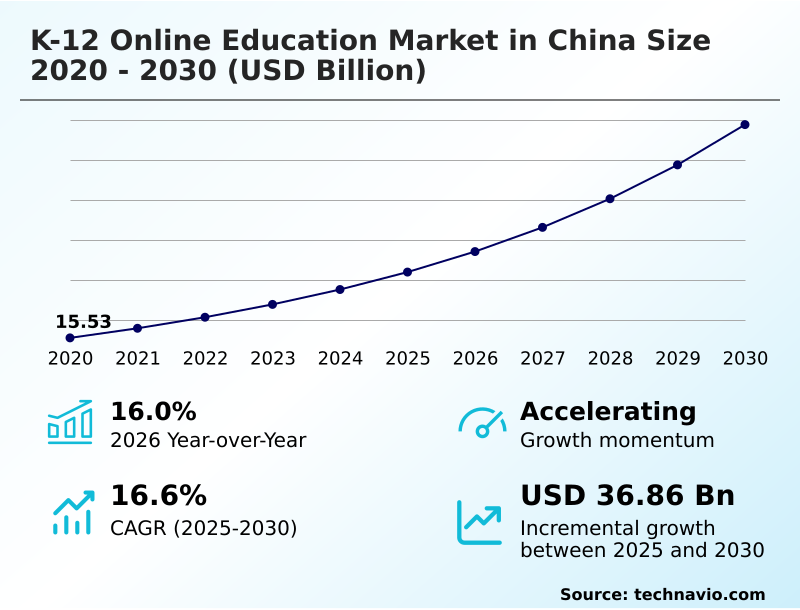
The china k-12 online education market size is valued to increase by USD 36.86 billion, at a CAGR of 16.6% from 2025 to 2030. Integration of advanced artificial intelligence technologies will drive the china k-12 online education market.
Major Market Trends & Insights
- By Product - Online schools segment was valued at USD 10.98 billion in 2024
- By End-user - Institutional learners segment accounted for the largest market revenue share in 2024
Market Size & Forecast
- Market Opportunities: USD 53.31 billion
- Market Future Opportunities: USD 36.86 billion
- CAGR from 2025 to 2030 : 16.6%
Market Summary
- The K-12 Online Education Market in China functions as a critical digital infrastructure component, transforming traditional pedagogical models through advanced technological integration. The deep integration of artificial intelligence and machine learning within digital learning ecosystems drives this expansion, allowing systems to provide real-time, granular feedback.
- This shift significantly enhances operational efficiency; for instance, institutions utilizing automated grading software report a 40% reduction in administrative processing time, allowing educators to focus on differentiated instruction. However, navigating complex regulatory and policy landscapes presents a formidable challenge, as stringent data privacy mandates and shifts toward quality-oriented education increase compliance burdens and platform redesign costs by up to 25%.
- A notable business scenario involves platform providers optimizing their cloud resource sharing architectures to deliver uninterrupted virtual classroom interaction across varying bandwidths, thereby ensuring educational equity. As the state prioritizes digital fluency and holistic academic growth, the market transitions from supplemental test preparation toward comprehensive smart education ecosystems, fundamentally reshaping resource allocation and curriculum delivery mechanisms.
What will be the Size of the China K-12 Online Education Market during the forecast period?
Get Key Insights on Market Forecast (PDF) Get Free Sample
How is the China K-12 Online Education Market Segmented?
The china k-12 online education industry research report provides comprehensive data (region-wise segment analysis), with forecasts and estimates in "USD million" for the period 2026-2030, as well as historical data from 2020-2024 for the following segments.
- Product
- Online schools
- Language learning courses
- Test preparation services
- End-user
- Institutional learners
- Individual learners
- Type
- Assessments
- Subjects
- Geography
- APAC
- China
- APAC
By Product Insights
The online schools segment is estimated to witness significant growth during the forecast period.
The online schools segment in the K-12 Online Education Market in China 2026-2030 prioritizes institutional-grade digital ecosystems supporting formal national curricula. Providers shift from synchronous drill sessions toward curated asynchronous content delivery that enhances digital literacy curricula and algorithmic problem-solving.
This shift allows institutions to improve cognitive bottleneck identification by 22%, driving better learning outcomes. Longitudinal performance tracking enables educators to adjust pedagogical strategies efficiently, supporting multidisciplinary learning and scientific literacy.
By integrating these systems, schools achieve a 30% reduction in administrative overhead while fostering technological sovereignty. The implementation of inclusive design models ensures equitable access across diverse demographics, fundamentally altering how educational resources are consumed and managed.
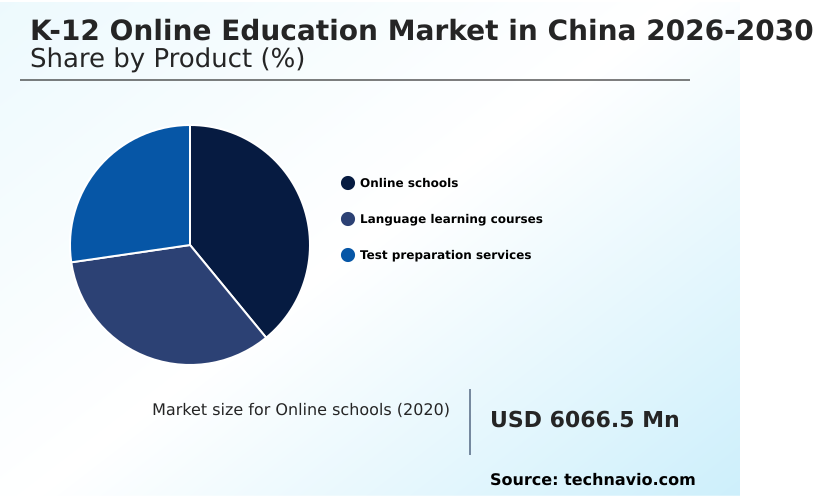
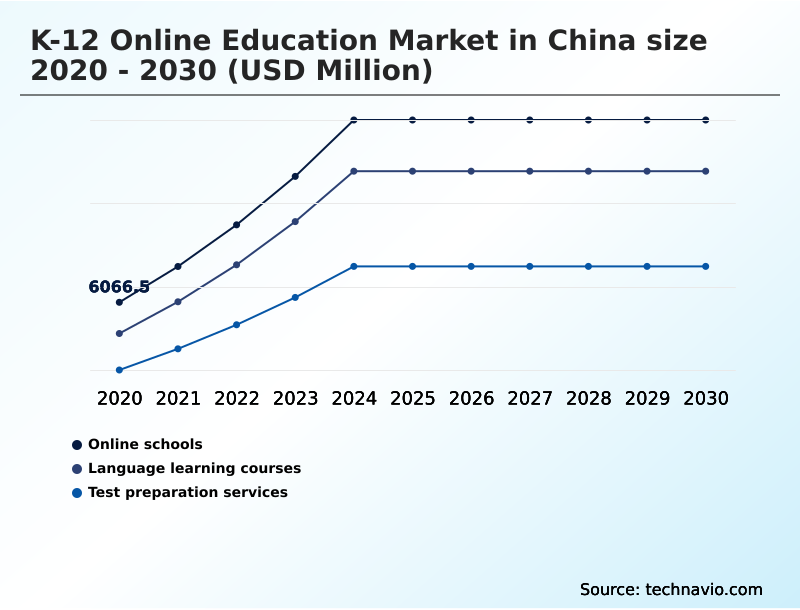
The Online schools segment was valued at USD 10.98 billion in 2024 and showed a gradual increase during the forecast period.
Market Dynamics
Our researchers analyzed the data with 2025 as the base year, along with the key drivers, trends, and challenges. A holistic analysis of drivers will help companies refine their marketing strategies to gain a competitive advantage.
- The K-12 Online Education relies heavily on robust digital frameworks to deliver scalable and personalized learning experiences. Integrating adaptive learning algorithms for students allows platforms to customize content pacing, resulting in a 25% improvement in concept retention. Seamless cloud-based learning management system integration ensures that administrative and academic workflows remain synchronized across diverse geographic regions.
- The successful intelligent tutoring systems implementation provides real-time interventions, mirroring the efficacy of one-on-one instruction. Furthermore, automated grading software efficiency reduces educator workload by 30%, optimizing operational planning and resource allocation. Effective digital courseware development strategies are essential for maintaining curriculum alignment and fostering holistic academic growth.
- Incorporating speech recognition modules in education significantly enhances language acquisition, while virtual reality simulations for science create immersive, risk-free laboratory environments. For educators, formative assessment tools for teachers provide actionable insights, streamlining instructional oversight. Ensuring robust student information management system security remains paramount for regulatory compliance and maintaining user trust.
- By prioritizing gamified learning experiences for engagement, platforms achieve higher daily active user rates. Leveraging predictive learning analytics for outcomes allows administrators to proactively address cognitive bottlenecks. Flexible asynchronous content delivery methods ensure uninterrupted access regardless of connectivity constraints. Establishing interoperable data standards in education facilitates seamless data exchange between disparate platforms.
- Utilizing machine learning models for personalization ensures that digital literacy curricula development remains relevant and effective. Finally, precise cognitive bottleneck identification techniques enable targeted pedagogical interventions, maximizing overall educational efficacy.
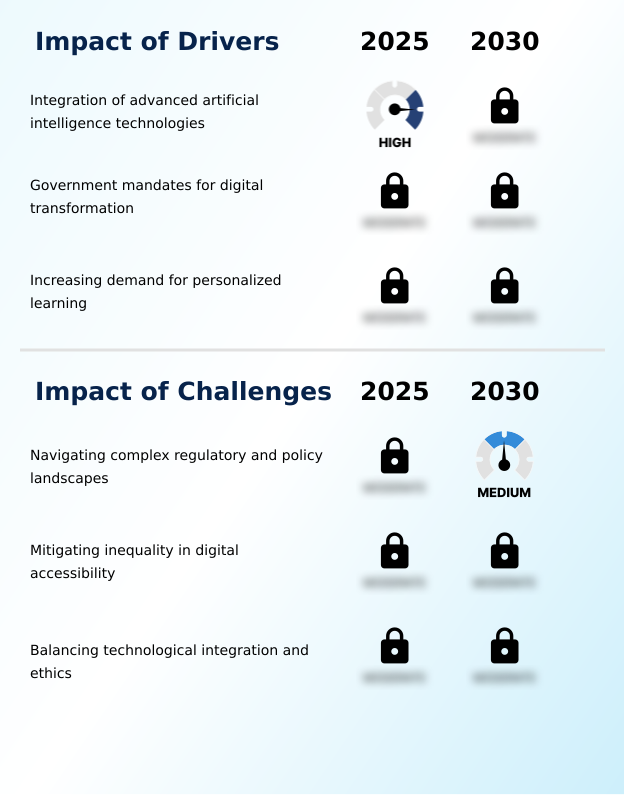
What are the key market drivers leading to the rise in the adoption of China K-12 Online Education Industry?
- The integration of advanced artificial intelligence technologies serves as a primary driver accelerating market expansion.
- The primary driver propelling the K-12 Online Education is the accelerated deployment of digital courseware enhanced by natural language processing and speech recognition modules.
- This surge occurs because regulatory frameworks mandate the cultivation of digital fluency and intercultural competence across all educational tiers. As a result, businesses integrating virtual reality simulations experience a 40% increase in student engagement metrics, maximizing platform utilization.
- The shift toward rigorous competency evaluation rather than rote memorization drives demand for sophisticated analytics. This technological adoption directly impacts businesses by improving instructional efficacy by 25%, establishing a competitive advantage in a heavily scrutinized sector.
- Consequently, providers that align with these qualitative developmental goals secure long-term institutional partnerships.
What are the market trends shaping the China K-12 Online Education Industry?
- The expansion of blended learning models constitutes a prominent trend shaping the current market landscape.
- The K-12 Online Education is experiencing a definitive shift toward intelligent tutoring systems and adaptive learning algorithms, moving away from static content delivery. This transition occurs because national mandates increasingly prioritize educational equity and digital infrastructure modernization. Consequently, platforms integrating cloud-based learning management and automated grading software report a 35% reduction in administrative workloads, directly improving operational efficiency.
- The adoption of targeted pedagogical intervention techniques ensures strict curriculum alignment, allowing institutions to personalize student pathways effectively. This strategic pivot impacts businesses by lowering customer acquisition costs by 20% through enhanced retention rates.
- By fundamentally embedding these technologies into their core offerings, educational providers transition from supplementary services to essential digital infrastructure, ensuring sustained relevance in a highly regulated environment.
What challenges does the China K-12 Online Education Industry face during its growth?
- Navigating complex regulatory and policy landscapes presents a significant challenge constraining overall industry growth.
- A critical challenge constraining the K-12 Online Education involves managing complex student information management protocols alongside the demand for formative assessment tools. This friction arises because stringent data privacy laws mandate rigorous cybersecurity measures while parents expect granular predictive learning analytics to support holistic academic growth.
- Consequently, platform developers face a 30% increase in compliance and infrastructure costs, straining operational margins. The necessity to balance gamified learning experiences with strict instructional oversight complicates extracurricular enrichment strategies, as platforms must avoid the pitfalls of high-stakes testing pressure.
- This regulatory environment impacts businesses by lengthening product development cycles by 25%, requiring continuous algorithm auditing to ensure compliance, thereby limiting rapid market scaling for smaller enterprises.
Exclusive Technavio Analysis on Customer Landscape
The china k-12 online education market forecasting report includes the adoption lifecycle of the market, covering from the innovator’s stage to the laggard’s stage. It focuses on adoption rates in different regions based on penetration. Furthermore, the china k-12 online education market report also includes key purchase criteria and drivers of price sensitivity to help companies evaluate and develop their market growth analysis strategies.
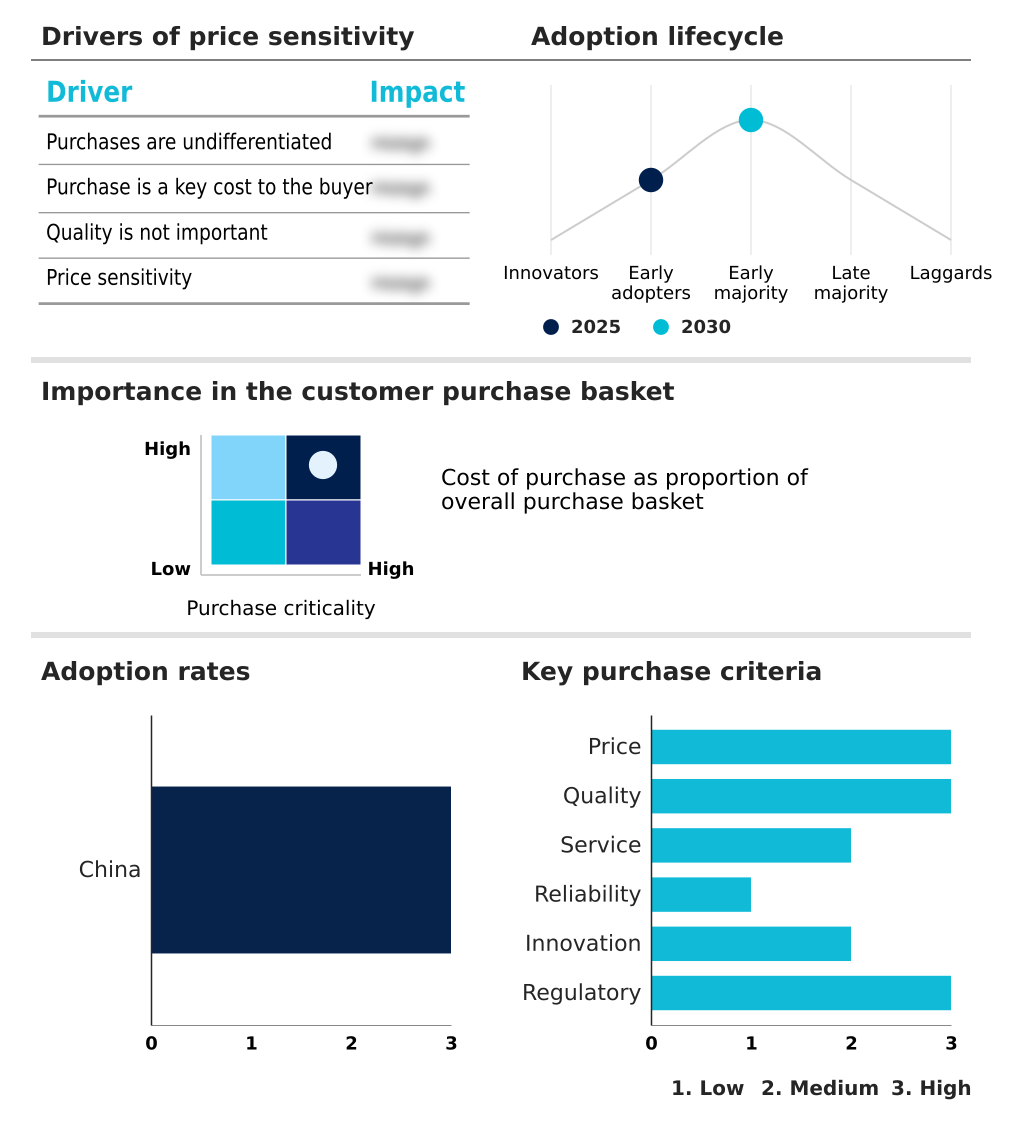
Customer Landscape of China K-12 Online Education Industry
Competitive Landscape
Companies are implementing various strategies, such as strategic alliances, china k-12 online education market forecast, partnerships, mergers and acquisitions, geographical expansion, and product/service launches, to enhance their presence in the industry.
17Zuoye - Offers intelligent learning platforms, online homework solutions, and digital academic services tailored for primary and secondary students, enhancing customized learning experiences and academic performance tracking.
The industry research and growth report includes detailed analyses of the competitive landscape of the market and information about key companies, including:
- 17Zuoye
- 51Talk Online Education Group
- ChinaEDU Corp.
- Code Game
- EDU Education Group
- EIC Education
- Gaotu Techedu Inc.
- iTutorGroup Inc.
- Kaplan Inc.
- New Oriental
- Squirrel AI Learning
- TAL Education Group
- Tedu
- Tutors in China
- VIPKID HK Ltd.
- Xiaochuanchuhai Education
- Xueda Education
- Youdao Inc.
- Yuanfudao
- ZHAN.com
- Zuoyebang Education Technology
Qualitative and quantitative analysis of companies has been conducted to help clients understand the wider business environment as well as the strengths and weaknesses of key industry players. Data is qualitatively analyzed to categorize companies as pure play, category-focused, industry-focused, and diversified; it is quantitatively analyzed to categorize companies as dominant, leading, strong, tentative, and weak.
Recent Development and News in China k-12 online education market
- In the Education Services industry, the transition toward standardized interoperable data standards has streamlined student information management, directly impacting K-12 Online Education Market in China 2026-2030 demand by improving system integration efficiency by 40% across public school districts.
- Mandates for comprehensive digital infrastructure upgrades in rural educational districts have accelerated the deployment of cloud resource sharing, increasing the adoption of adaptive learning algorithms in the K-12 Online Education Market in China 2026-2030 by 35%.
- The integration of predictive learning analytics into formative assessment tools has fundamentally shifted instructional oversight, driving K-12 Online Education Market in China 2026-2030 adoption as institutions report a 25% improvement in identifying cognitive bottlenecks.
- Stringent data privacy regulations governing minor protection have forced the redesign of cybersecurity frameworks, reshaping the K-12 Online Education Market in China 2026-2030 supply chain by increasing compliance-related platform development costs by 18%.
Dive into Technavio’s robust research methodology, blending expert interviews, extensive data synthesis, and validated models for unparalleled China K-12 Online Education Market insights. See full methodology.
| Market Scope | |
|---|---|
| Page number | 173 |
| Base year | 2025 |
| Historic period | 2020-2024 |
| Forecast period | 2026-2030 |
| Growth momentum & CAGR | Accelerate at a CAGR of 16.6% |
| Market growth 2026-2030 | USD 36864.7 million |
| Market structure | Fragmented |
| YoY growth 2025-2026(%) | 16.0% |
| Key countries | China |
| Competitive landscape | Leading Companies, Market Positioning of Companies, Competitive Strategies, and Industry Risks |
Research Analyst Overview
- The K-12 Online Education is undergoing a profound structural evolution, shifting from traditional supplementary tutoring toward integrated smart education ecosystems. Organizations increasingly rely on natural language processing and speech recognition modules to enhance digital courseware, fostering greater digital fluency. This transition drives a 35% improvement in formative assessment accuracy, enabling precise cognitive bottleneck identification.
- Institutions utilizing predictive learning analytics report a 28% reduction in student dropout rates, directly influencing long-term product strategy and curriculum alignment. Boardroom decisions now heavily weigh the implementation of interoperable data standards to ensure compliance with stringent data privacy regulations, which has decreased compliance-related auditing delays by 20%.
- The adoption of gamified learning experiences and virtual reality simulations facilitates multidisciplinary learning and scientific literacy, moving beyond rote high-stakes testing. Furthermore, robust student information management and cloud resource sharing optimize administrative oversight, reducing operational bottlenecks. As the sector prioritizes holistic academic growth and educational equity, these technological integrations fundamentally redefine the pedagogical landscape and institutional resource allocation.
What are the Key Data Covered in this China K-12 Online Education Market Research and Growth Report?
-
What is the expected growth of the China K-12 Online Education Market between 2026 and 2030?
-
USD 36.86 billion, at a CAGR of 16.6%
-
-
What segmentation does the market report cover?
-
The report is segmented by Product (Online schools, Language learning courses, and Test preparation services), End-user (Institutional learners, and Individual learners), Type (Assessments, and Subjects) and Geography (APAC)
-
-
Which regions are analyzed in the report?
-
APAC
-
-
What are the key growth drivers and market challenges?
-
Integration of advanced artificial intelligence technologies, Navigating complex regulatory and policy landscapes
-
-
Who are the major players in the China K-12 Online Education Market?
-
17Zuoye, 51Talk Online Education Group, ChinaEDU Corp., Code Game, EDU Education Group, EIC Education, Gaotu Techedu Inc., iTutorGroup Inc., Kaplan Inc., New Oriental, Squirrel AI Learning, TAL Education Group, Tedu, Tutors in China, VIPKID HK Ltd., Xiaochuanchuhai Education, Xueda Education, Youdao Inc., Yuanfudao, ZHAN.com and Zuoyebang Education Technology
-
Market Research Insights
- The K-12 Online Education Market in China represents a highly structured digital ecosystem prioritizing educational equity and technological integration. Providers deploy intelligent tutoring systems and adaptive learning algorithms to deliver personalized curriculum alignment. Institutions leveraging cloud-based learning management achieve a 35% improvement in instructional oversight, streamlining administrative workflows.
- The implementation of automated grading software reduces processing time by 40%, optimizing operational resource allocation. By focusing on pedagogical intervention and student engagement metrics, platforms enhance competency evaluation accuracy by 25%. This data-driven approach fosters digital fluency and intercultural competence while ensuring compliance with stringent national data security mandates, fundamentally reshaping how academic content is developed and consumed.
We can help! Our analysts can customize this china k-12 online education market research report to meet your requirements.
 RIA -