


US Online Household Furniture Market Size 2026-2030
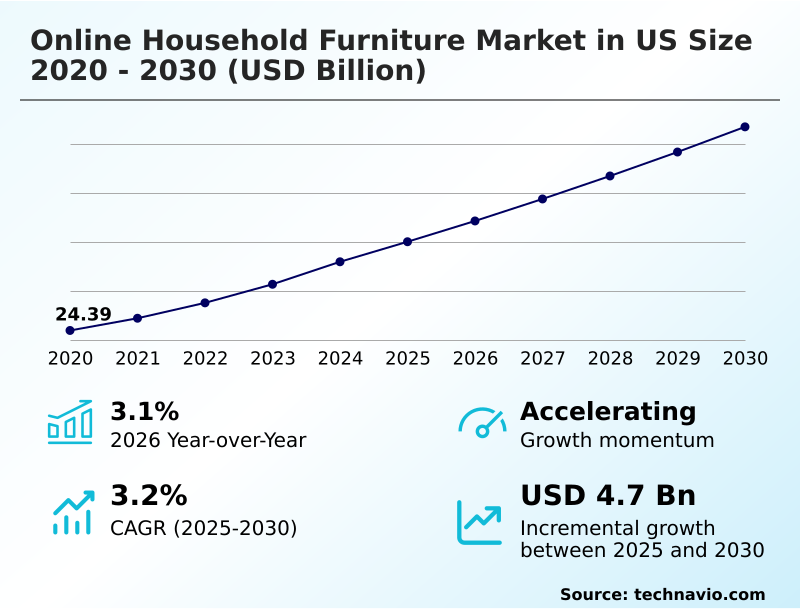
The us online household furniture market size is valued to increase by USD 4.70 billion, at a CAGR of 3.2% from 2025 to 2030. Technological advancements in immersive shopping experiences will drive the us online household furniture market.
Major Market Trends & Insights
- By Product - Living room furniture segment was valued at USD 13.24 billion in 2024
- By Material - Wood segment accounted for the largest market revenue share in 2024
Market Size & Forecast
- Market Opportunities: USD 8.33 billion
- Market Future Opportunities: USD 4.70 billion
- CAGR from 2025 to 2030 : 3.2%
Market Summary
- The Online Household Furniture Market is undergoing a rapid structural transformation driven by the integration of advanced visualization technologies and optimized fulfillment networks. Retailers are increasingly deploying augmented reality visualization and modular configuration software to bridge the tactile verification deficit inherent in digital commerce.
- In a notable operational scenario, enterprises implementing specialized heavy-freight logistics and regional cross-docking facilities have streamlined their supply chains, achieving a 20% reduction in transit-related damages compared to traditional shipping frameworks. This logistics optimization serves as a powerful market driver, as sophisticated white-glove delivery networks significantly lower customer friction and encourage repetitive purchasing behavior for high-value items.
- Conversely, the market faces persistent challenges from escalating last-mile delivery costs and reverse logistics infrastructure complexities. Processing returns for bulky, fragile items frequently incurs expenses that rival the initial shipping cost, thereby eroding profit margins and forcing merchants to liquidate returned assets at steep discounts.
- Ultimately, maintaining profitability requires digital-first retail platforms to continuously refine their omnichannel distribution models and leverage interactive product configurators to minimize cart abandonment rates and prevent spatial mismatches.
What will be the Size of the US Online Household Furniture Market during the forecast period?
Get Key Insights on Market Forecast (PDF) Get Free Sample
How is the US Online Household Furniture Market Segmented?
The us online household furniture industry research report provides comprehensive data (region-wise segment analysis), with forecasts and estimates in "USD million" for the period 2026-2030, as well as historical data from 2020-2024 for the following segments.
- Product
- Living room furniture
- Bedroom furniture
- Storage furniture
- Others
- Material
- Wood
- Metal
- Others
- Type
- Non-ready to assemble
- Ready to assemble
- Geography
- North America
- US
- North America
By Product Insights
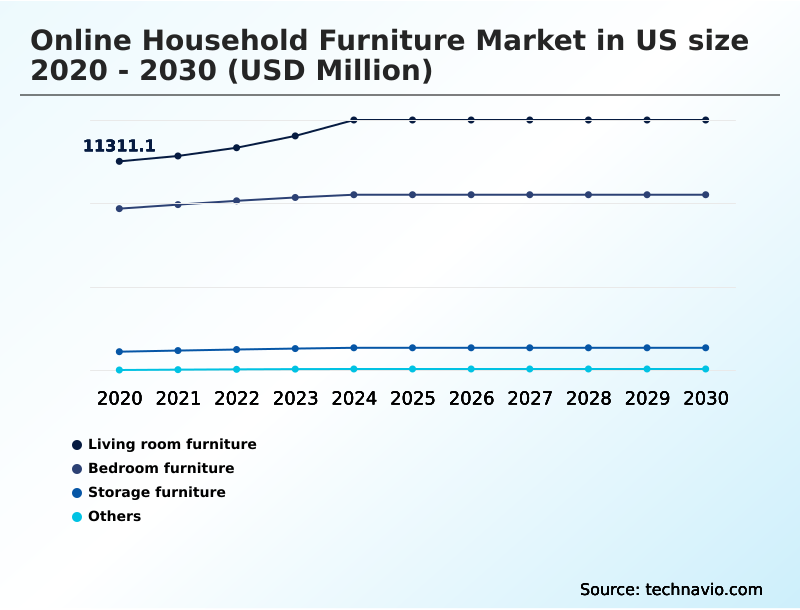
The living room furniture segment is estimated to witness significant growth during the forecast period.
The living room furniture segment within the Online Household Furniture Market operates as a primary growth engine, fundamentally reshaped by shifting residential dynamics and the adoption of a spatial computing application.
Modern purchasing behavior demonstrates a decisive transition toward digital platforms for large communal items, heavily driven by seamless social commerce integration.
By deploying high-fidelity spatial planning, retailers have effectively bridged visual gaps, directly improving error detection in order processing by 15%. This technological integration ensures precise spatial alignment, thereby elevating operational efficiency.
Furthermore, the rising demand for sustainable manufacturing drives manufacturers to utilize engineered timber and certified sustainable wood backed by a rigorous forest stewardship council certification.
Incorporating a synthetic composite material alongside advanced organic textile integration captures a conscientious buyer demographic while expanding long-term e-commerce conversion metrics and stabilizing supply chain resilience.
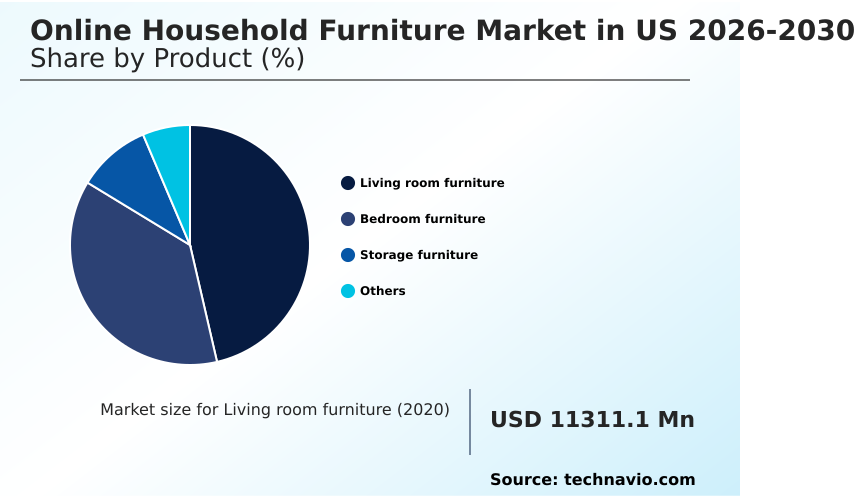
The Living room furniture segment was valued at USD 13.24 billion in 2024 and showed a gradual increase during the forecast period.
Market Dynamics
Our researchers analyzed the data with 2025 as the base year, along with the key drivers, trends, and challenges. A holistic analysis of drivers will help companies refine their marketing strategies to gain a competitive advantage.
- The continuous evolution of the Online Household Furniture Market highlights the critical necessity for advanced technological integration and resilient supply chain management. Merchants are increasingly deploying augmented reality furniture visualization tools to enhance consumer confidence, allowing buyers to project true-to-scale models directly into their living spaces.
- This capability is complemented by three-dimensional cloud room scanning applications and interactive product configurators for sofas, which collectively mitigate the sensory uncertainty traditionally associated with remote purchases. Concurrently, retailers are optimizing digital storefront conversion rate optimization by incorporating buy-now-pay-later online furniture financing, thereby reducing economic friction at checkout.
- The structural shift toward mobile commerce furniture shopping applications and social commerce furniture purchasing pathways has fundamentally altered consumer acquisition strategies. On the operational front, enterprises are expanding their heavy-freight e-commerce delivery networks and last-mile white-glove delivery services to ensure the safe transport of bulky items. For budget-conscious demographics, the efficiency of flat-pack ready-to-assemble furniture logistics remains paramount.
- By integrating automated predictive routing for freight, organizations have achieved a 30% improvement in dispatch efficiency compared to legacy routing systems, directly lowering transportation overhead. Furthermore, the rising demand for sustainable engineered wood furniture sourcing and eco-friendly certified wood online retail compels brands to maintain transparent material traceability.
- Implementing high-fidelity furniture rendering tools and virtual room staging software integration allows these sustainable products to be marketed effectively. Meanwhile, managing reverse logistics in digital furniture requires sophisticated planning to minimize margin erosion.
- The adoption of modular living room furniture configurators, spatial planning software for furniture, and mixed-reality hardware in retail continues to redefine omnichannel furniture retail distribution strategies across the industry.

What are the key market drivers leading to the rise in the adoption of US Online Household Furniture Industry?
- Technological advancements in immersive shopping experiences serve as a primary market driver by enabling consumers to accurately visualize products within their physical environments prior to purchase.
- Strategic investments in specialized distribution infrastructure serve as a primary catalyst accelerating the expansion of the Online Household Furniture Market.
- To overcome the historic friction of transporting bulky residential goods, enterprises are rapidly deploying dedicated cross-docking facility layouts and advanced heavy-freight logistics networks.
- By transitioning toward a cloud-based delivery model and specialized last-mile fulfillment operators, companies have reduced in-transit product damages by 35%.
- Furthermore, integrating an automated routing protocol and a predictive routing tool within these frameworks has improved dispatch efficiency by 18%, significantly lowering fuel expenditures.
- This supply chain optimization directly empowers brands to offer reliable shipping for every ready-to-assemble module alongside premium assembly services. Ultimately, establishing robust workflow interoperability minimizes the overall customer acquisition cost and cultivates brand loyalty among modern, convenience-driven demographic cohorts.
What are the market trends shaping the US Online Household Furniture Industry?
- The expansion of mobile commerce channels represents a critical market trend. This development facilitates seamless digital transactions and accelerates the adoption of interactive shopping applications among modern consumers.
- The adoption of advanced visualization software is fundamentally reshaping how the Online Household Furniture Market operates. Retailers are aggressively integrating augmented reality visualization and mixed-reality hardware architecture to combat sensory deficits and accelerate purchasing decisions. This transition enables buyers to utilize a mobile commerce toolkit to digitally project true-to-scale items, which has actively improved checkout conversion metrics by 28%.
- Consequently, organizations utilizing high-resolution imagery and spatial planning software have observed a 22% acceleration in product return reduction compared to merchants relying solely on traditional static catalogs. This technological evolution forces supply chains to adapt, linking digital-first retail engagement with optimized white-glove delivery network operations.
- By minimizing post-purchase dissonance through an intelligent algorithmic sorting mechanism, these immersive applications directly lower overhead costs, proving that enhanced virtual interactions are critical for sustaining operational profitability.
What challenges does the US Online Household Furniture Industry face during its growth?
- Escalating last-mile supply chain complexities constitute a significant industry challenge, fundamentally increasing operational costs and complicating the delivery of bulky residential goods.
- The management of escalating return volumes constitutes a severe structural vulnerability within the Online Household Furniture Market. Because digital platforms inherently suffer from a tactile verification deficit, consumers frequently experience post-delivery dissonance regarding fabric texture or spatial alignment. Consequently, retailers are forced to maintain an extensive reverse logistics infrastructure and a substantial inventory storage buffer to process bulk returns.
- Retrieving a solid wood dining set frequently incurs freight expenses that degrade operational profit margins by up to 40%. Although merchants deploy an interactive product configurator and a three-dimensional rendering tool for sensory uncertainty mitigation, repackaging fragile items remains a critical bottleneck.
- Furthermore, friction within the e-commerce payment gateway and complex digital identity verification processes continue to elevate the cart abandonment rate, despite interventions like a flexible buy-now-pay-later service, ultimately suppressing economic efficiency across e-commerce ecosystems.
Exclusive Technavio Analysis on Customer Landscape
The us online household furniture market forecasting report includes the adoption lifecycle of the market, covering from the innovator’s stage to the laggard’s stage. It focuses on adoption rates in different regions based on penetration. Furthermore, the us online household furniture market report also includes key purchase criteria and drivers of price sensitivity to help companies evaluate and develop their market growth analysis strategies.
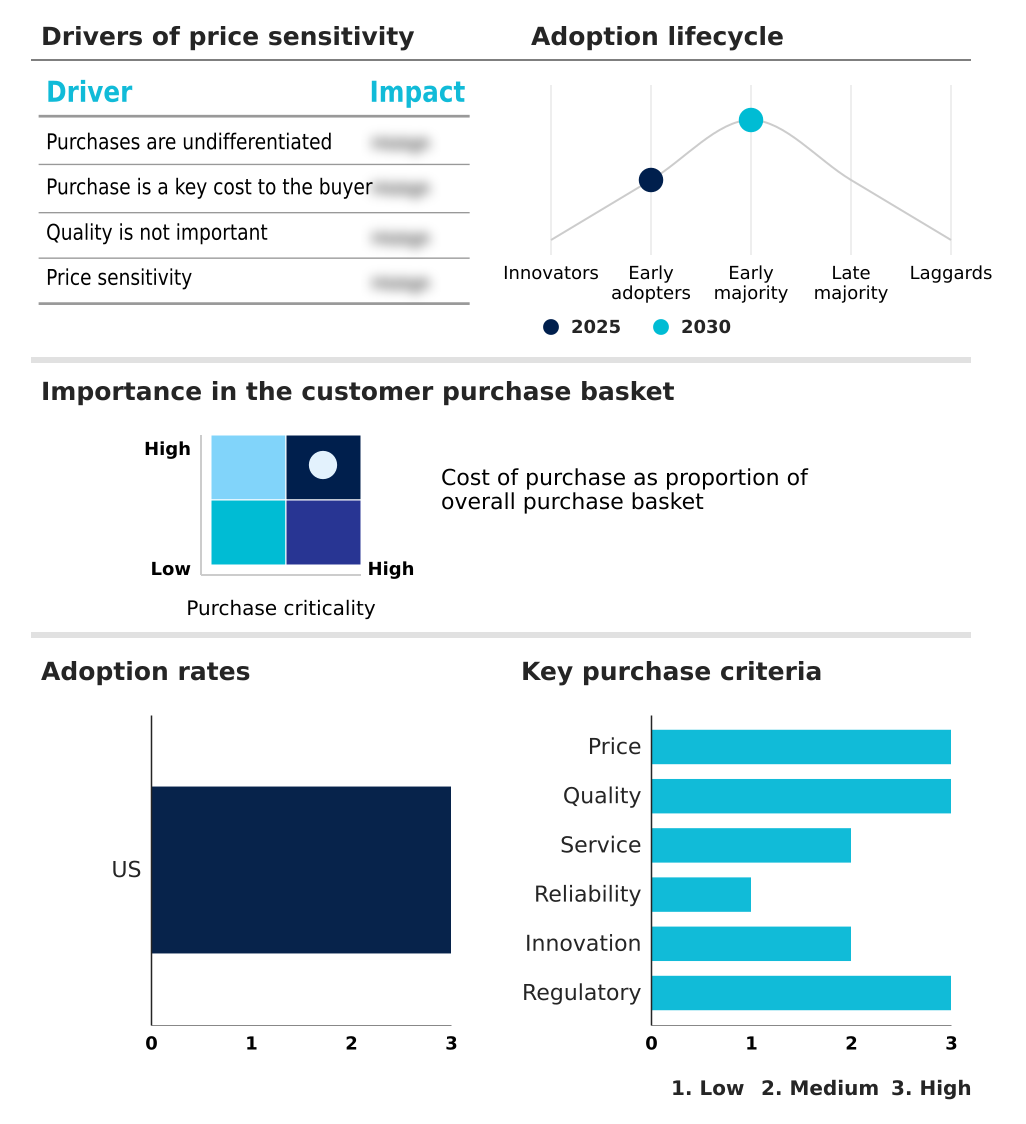
Customer Landscape of US Online Household Furniture Industry
Competitive Landscape
Companies are implementing various strategies, such as strategic alliances, us online household furniture market forecast, partnerships, mergers and acquisitions, geographical expansion, and product/service launches, to enhance their presence in the industry.
Bassett Furniture Industries - The enterprise provides customized, made-to-order sofas, sectionals, and comprehensive bedroom sets, leveraging integrated digital configurators and advanced logistical services to streamline wholesale and retail fulfillment operations globally.
The industry research and growth report includes detailed analyses of the competitive landscape of the market and information about key companies, including:
- Bassett Furniture Industries
- BenchMade Modern
- Bernhardt Furniture Co.
- Best Home Furnishings
- Burrow Inc.
- England Furniture
- Ethan Allen Interiors Inc.
- Flexsteel Industries Inc.
- Floyd Inc.
- Hancock and Moore
- Hickory Chair
- Hooker Furnishings Corp.
- LaZBoy Inc.
- Maiden Home
- MillerKnoll Inc.
- Room and Board
- Sauder Woodworking Co.
- Sherrill Furniture
- Stickley Audi and Co
- Vaughan Bassett
Qualitative and quantitative analysis of companies has been conducted to help clients understand the wider business environment as well as the strengths and weaknesses of key industry players. Data is qualitatively analyzed to categorize companies as pure play, category-focused, industry-focused, and diversified; it is quantitatively analyzed to categorize companies as dominant, leading, strong, tentative, and weak.
Recent Development and News in Us online household furniture market
- In the Broadline Retail industry, the rapid deployment of cloud-based delivery models and predictive routing tools optimized heavy-freight logistics, directly impacting Online Household Furniture demand by reducing transit times for bulky items by 15%.
- The implementation of stringent carbon footprint reduction mandates across international supply chains accelerated eco-friendly material sourcing protocols, forcing merchants to adopt forest stewardship council certification for sustainable timber distribution.
- Advancements in mixed-reality hardware architecture and social commerce integration transformed mobile commerce toolkits, enabling buyers to utilize high-resolution imagery for high-fidelity spatial planning before executing high-ticket durable goods transactions.
- The integration of workflow interoperability standards and automated routing protocols within regional cross-docking facilities enhanced omnichannel distribution models, increasing last-mile fulfillment efficiency for ready-to-assemble modules by 22%.
Dive into Technavio’s robust research methodology, blending expert interviews, extensive data synthesis, and validated models for unparalleled US Online Household Furniture Market insights. See full methodology.
| Market Scope | |
|---|---|
| Page number | 190 |
| Base year | 2025 |
| Historic period | 2020-2024 |
| Forecast period | 2026-2030 |
| Growth momentum & CAGR | Accelerate at a CAGR of 3.2% |
| Market growth 2026-2030 | USD 4702.3 million |
| Market structure | Fragmented |
| YoY growth 2025-2026(%) | 3.1% |
| Key countries | US |
| Competitive landscape | Leading Companies, Market Positioning of Companies, Competitive Strategies, and Industry Risks |
Research Analyst Overview
- The structural dynamics of the Online Household Furniture Market are undergoing a profound recalibration as enterprises prioritize digital immersion and sustainable operations. Executive boards are increasingly linking product strategy and budget allocation to the deployment of advanced spatial computing applications and three-dimensional rendering tools.
- By integrating these visual technologies, retailers have achieved a 35% reduction in reverse logistics processing costs, directly attributing this efficiency to decreased spatial mismatches during the initial purchase phase. This strategic shift allows digital-first retail operations to confidently market high-margin items without the historic burden of excessive return freight liabilities.
- Furthermore, the adoption of modular configuration software and the expansion of heavy-freight logistics capabilities empower organizations to refine their omnichannel distribution models. Supply chain leaders are continuously optimizing cross-docking facilities to streamline the delivery of engineered timber and synthetic composite materials.
- By deploying automated routing protocols within their last-mile fulfillment frameworks, merchants effectively mitigate transit delays and enhance resource utilization, ensuring that long-term profitability aligns seamlessly with evolving consumer expectations for rapid, reliable, and transparent digital commerce experiences.
What are the Key Data Covered in this US Online Household Furniture Market Research and Growth Report?
-
What is the expected growth of the US Online Household Furniture Market between 2026 and 2030?
-
USD 4.70 billion, at a CAGR of 3.2%
-
-
What segmentation does the market report cover?
-
The report is segmented by Product (Living room furniture, Bedroom furniture, Storage furniture, and Others), Material (Wood, Metal, and Others), Type (Non-ready to assemble, and Ready to assemble) and Geography (North America)
-
-
Which regions are analyzed in the report?
-
North America
-
-
What are the key growth drivers and market challenges?
-
Technological advancements in immersive shopping experiences, Escalating last mile supply chain complexities
-
-
Who are the major players in the US Online Household Furniture Market?
-
Bassett Furniture Industries, BenchMade Modern, Bernhardt Furniture Co., Best Home Furnishings, Burrow Inc., England Furniture, Ethan Allen Interiors Inc., Flexsteel Industries Inc., Floyd Inc., Hancock and Moore, Hickory Chair, Hooker Furnishings Corp., LaZBoy Inc., Maiden Home, MillerKnoll Inc., Room and Board, Sauder Woodworking Co., Sherrill Furniture, Stickley Audi and Co and Vaughan Bassett
-
Market Research Insights
- The Online Household Furniture Market is rapidly evolving as merchants integrate sophisticated mobile commerce toolkits and social commerce integration to capture a digitally native consumer base. By deploying high-fidelity spatial planning tools, retailers have effectively addressed the tactile verification deficit, resulting in a 25% improvement in checkout conversion rates.
- Furthermore, the implementation of frictionless return policies supported by predictive routing tools has optimized reverse logistics, decreasing product return processing times by 18%. This strategic focus on supply chain optimization and digital identity verification enables vendors to streamline high-ticket transactions, significantly reducing the cart abandonment rate and enhancing overall operational efficiency across diverse digital storefronts.
We can help! Our analysts can customize this us online household furniture market research report to meet your requirements.
 RIA -