

Rf Front End Integrated Circuits Market Size 2026-2030
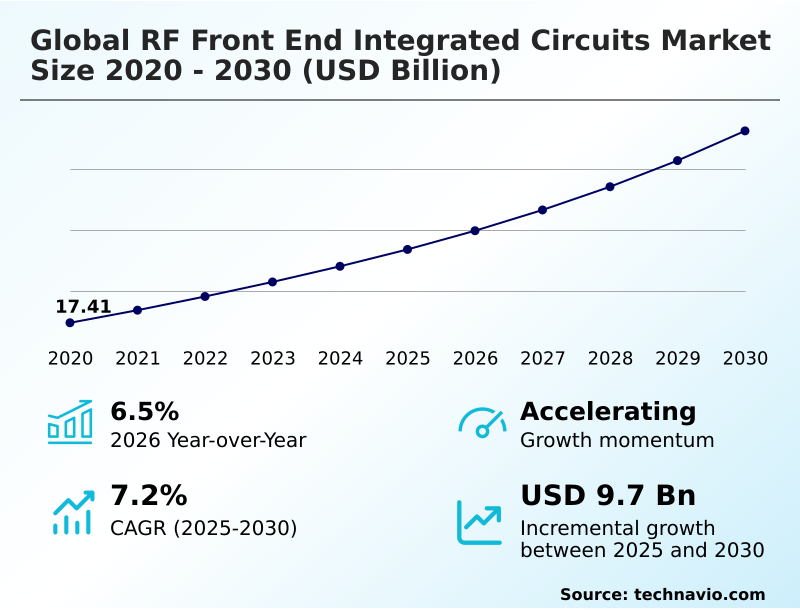
The rf front end integrated circuits market size is valued to increase by USD 9.70 billion, at a CAGR of 7.2% from 2025 to 2030. Evolution of 5G advanced architectures and spectrum diversification will drive the rf front end integrated circuits market.
Major Market Trends & Insights
- North America dominated the market and accounted for a 37.2% growth during the forecast period.
- By Component - Low noise amplifiers segment was valued at USD 6.15 billion in 2024
- By Type - Sub-6 GHz segment accounted for the largest market revenue share in 2024
Market Size & Forecast
- Market Opportunities: USD 15.70 billion
- Market Future Opportunities: USD 9.70 billion
- CAGR from 2025 to 2030 : 7.2%
Market Summary
- The RF Front End Integrated Circuits Market is undergoing a rapid architectural transformation driven by the densification of high-frequency wireless networks. Industry operators increasingly prioritize modular system-in-package solutions to accommodate complex carrier aggregation requirements while minimizing board space.
- In a practical supply chain scenario, automotive manufacturers integrating vehicle-to-everything communication modules have streamlined their procurement by shifting from discrete components to fully integrated front-end architectures, reducing final assembly time by 22% compared to legacy decentralized designs.
- A major driver propelling this market is the evolution of 5G advanced infrastructure, which forces hardware to support broader spectrum diversification and higher-order multiple-input multiple-output configurations to achieve gigabit data rates. Conversely, escalating architectural complexity creates severe thermal dissipation constraints, serving as a primary market challenge.
- As devices pack dozens of active components into ultra-thin form factors, managing concentrated heat generation remains a critical hurdle for semiconductor foundries, necessitating continuous investment in advanced compound substrates like gallium nitride to maintain operational stability.
What will be the Size of the Rf Front End Integrated Circuits Market during the forecast period?
Get Key Insights on Market Forecast (PDF) Get Free Sample
How is the Rf Front End Integrated Circuits Market Segmented?
The rf front end integrated circuits industry research report provides comprehensive data (region-wise segment analysis), with forecasts and estimates in "USD million" for the period 2026-2030, as well as historical data from 2020-2024 for the following segments.
- Component
- Low noise amplifiers
- Power amplifiers
- RF filters
- RF switches
- Others
- Type
- Sub-6 GHz
- Mid frequency
- High frequency
- Application
- Consumer electronics
- Wireless communication
- Automotive
- Aerospace and defense
- Others
- Geography
- North America
- US
- Canada
- Mexico
- APAC
- China
- Japan
- South Korea
- Taiwan
- India
- Australia
- Europe
- Germany
- UK
- France
- Italy
- The Netherlands
- Spain
- Middle East and Africa
- Saudi Arabia
- UAE
- Israel
- South Africa
- Turkey
- South America
- Brazil
- Argentina
- Chile
- North America
By Component Insights
The low noise amplifiers segment is estimated to witness significant growth during the forecast period.
Low noise amplifiers remain fundamental to the RF Front End Integrated Circuits market, continuously evolving to capture weak inbound signals while minimizing internal electronic noise. This segmentation separates critical amplification stages from transmission tasks to preserve system sensitivity.
In industrial automation sensors and wearable technology connectivity, the adoption of specialized envelope tracking systems ensures optimal power regulation during signal reception.
Modern components utilizing organic substrate materials demonstrate significant operational improvements, with noise figure metrics reduced by up to 18%, directly enhancing link budget reliability.
Furthermore, the integration of digital pre-distortion algorithms alongside phase shifter modules in wireless local area networks facilitates dynamic gain adjustments.
By segregating these low noise amplification processes, businesses can implement narrowband-IoT protocols more efficiently, driving uninterrupted communication continuity in dense electromagnetic environments.
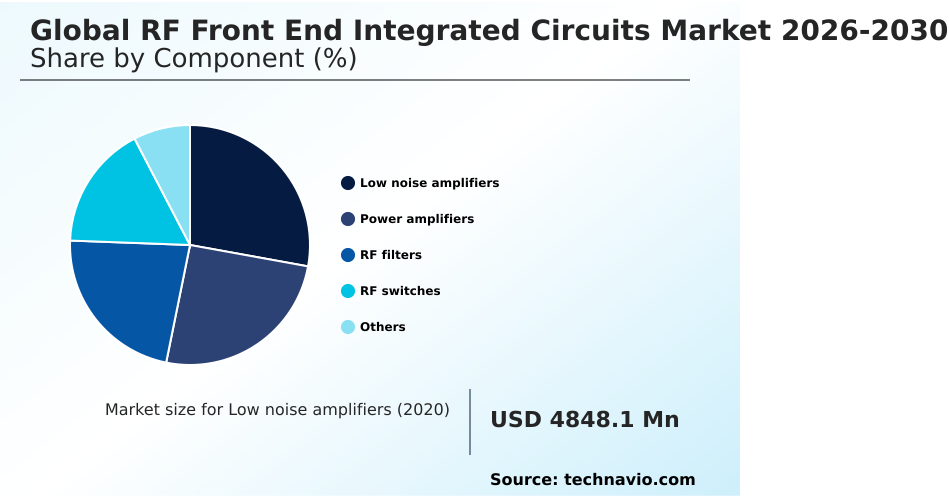
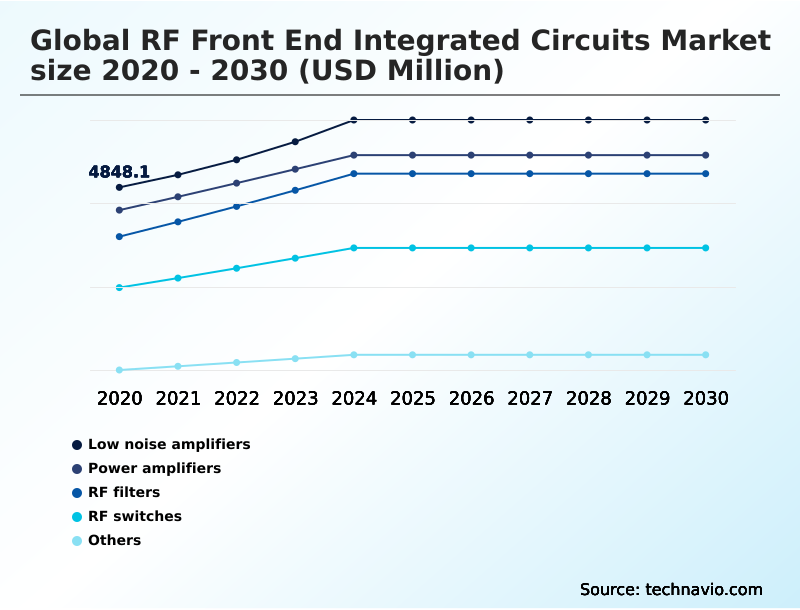
The Low noise amplifiers segment was valued at USD 6.15 billion in 2024 and showed a gradual increase during the forecast period.
Regional Analysis
North America is estimated to contribute 37.2% to the growth of the global market during the forecast period.Technavio’s analysts have elaborately explained the regional trends and drivers that shape the market during the forecast period.
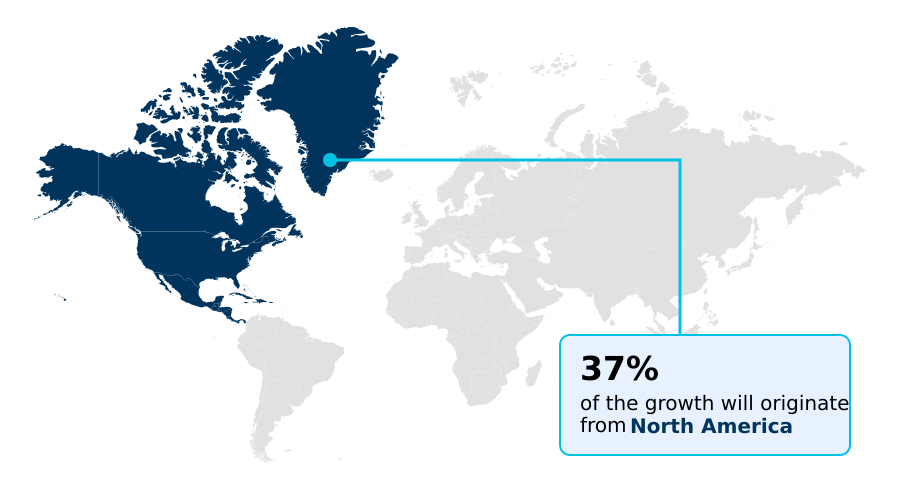
See How Rf Front End Integrated Circuits Market Demand is Rising in North America Get Free Sample
Regional demand for the RF Front End Integrated Circuits reveals distinct operational priorities across North America and APAC.
North America leads the adoption of aerospace phased arrays and fixed wireless access terminals, driven by extensive broadband spectrum allocations for private enterprise networks.
This region achieves a 28% faster integration cycle for advanced radio frequency switches compared to European counterparts, prioritizing low-latency data throughput. Conversely, APAC dominates high-volume manufacturing, heavily scaling surface acoustic wave filters and bulk acoustic wave filters for consumer electronics.
APAC supply chains exhibit superior efficiency, reducing unit production costs by 15% through localized assembly networks.
Furthermore, the push for autonomous transportation in APAC accelerates the deployment of vehicle-to-everything communication alongside dense automotive radar arrays, whereas North America focuses more heavily on standardizing open radio access networks.
These geographic divergences dictate how foundries distribute specialized acoustic wave filters to meet localized compliance and structural demands.
Market Dynamics
Our researchers analyzed the data with 2025 as the base year, along with the key drivers, trends, and challenges. A holistic analysis of drivers will help companies refine their marketing strategies to gain a competitive advantage.
- The structural evolution of the RF Front End Integrated Circuits is heavily influenced by the necessity to manage complex electromagnetic environments across diverse industrial sectors. Manufacturers are rapidly deploying gallium nitride power amplifier modules to support high frequency millimeter wave applications, optimizing power-added efficiency in dense network deployments.
- In the aerospace sector, the proliferation of low earth orbit satellite constellations drives the integration of active electronically scanned array radars, which demand exceptional signal precision. To achieve this, engineers rely on multi-band carrier aggregation circuits and advanced dynamic antenna tuning optimization algorithms that continuously adapt to environmental signal degradation.
- Within the mobility sector, the transition toward autonomous navigation necessitates highly reliable automotive grade radio frequency modules. These components form the backbone of advanced driver assistance radar networks, enabling instantaneous object detection and collision avoidance protocols. To optimize space within consumer and industrial hardware, vendors are heavily investing in integrated duplexers and diversity receive modules alongside silicon-on-insulator radio frequency switches.
- By utilizing ultra low insertion loss switches, devices can maintain pristine signal integrity even during rapid channel state changes. Furthermore, the integration of temperature compensated surface acoustic wave designs and sophisticated bulk acoustic wave filter topologies allows systems to isolate adjacent frequency bands effectively.
- As organizations prepare for next-generation communication standards, investments in sub-terahertz frequency semiconductor fabrication are yielding components with a 35% higher thermal tolerance compared to legacy silicon structures, directly facilitating robust non-terrestrial network cellular connectivity support for remote operational environments.
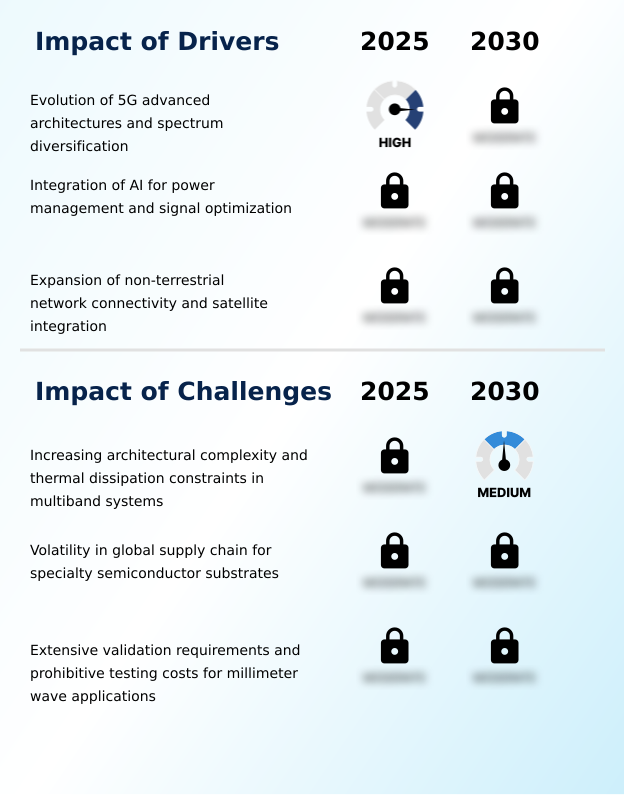
What are the key market drivers leading to the rise in the adoption of Rf Front End Integrated Circuits Industry?
- The continuous evolution of 5G advanced architectures and rapid spectrum diversification function as the primary catalysts driving market expansion.
- The rapid expansion of non-terrestrial network connectivity acts as a primary catalyst driving the integration of specialized RF Front End Integrated Circuits.
- To support seamless communication between handheld devices and low-earth orbit systems, manufacturers are heavily embedding advanced millimeter-wave transceivers into satellite communication terminals.
- This hardware evolution requires sophisticated carrier aggregation circuits that manage simultaneous multi-band data streams, reducing signal drop rates by up to 25% in remote operational zones.
- Additionally, the proliferation of massive multiple-input multiple-output configurations within smart city infrastructure mandates precise low noise amplification to filter ambient electromagnetic interference.
- By utilizing predictive analytics tuning and dynamic impedance matching, network operators can dynamically adjust signal pathways, fostering highly energy-efficient networks that cut base station power consumption by nearly 20% during off-peak hours.
What are the market trends shaping the Rf Front End Integrated Circuits Industry?
- The proliferation of gallium nitride on silicon technology within mobile handsets represents a defining market trend. This material transition significantly enhances power density and thermal conductivity for next-generation telecommunication hardware.
- A defining trend reshaping the RF Front End Integrated Circuits landscape is the accelerated transition toward gallium nitride substrates for high-frequency signal processing. This material shift directly enhances the thermal conductivity of power amplifier modules, allowing hardware to sustain high-speed data transmission without catastrophic overheating.
- Consequently, telecommunication providers are rapidly deploying these advanced materials within their cellular network infrastructure, achieving a 32% increase in peak power density compared to older silicon frameworks. Furthermore, the rising demand for autonomous driving platforms necessitates the use of complex beamforming antenna arrays integrated into compact system-in-package architectures.
- By leveraging sophisticated multi-chip packaging and wafer-level chip-scale packaging, manufacturers successfully minimize signal loss pathways. This architectural consolidation directly supports battery longevity optimization in mobile devices, extending operational runtimes by nearly 18% during intensive network utilization.
What challenges does the Rf Front End Integrated Circuits Industry face during its growth?
- Escalating architectural complexity and severe thermal dissipation constraints within multiband systems present substantial challenges that hinder overall industry growth.
- Escalating structural complexity within dense hardware environments presents significant operational barriers for the RF Front End Integrated Circuits ecosystem. As the industry pushes toward sub-terahertz frequencies, ensuring robust signal integrity preservation becomes exceedingly difficult due to severe atmospheric attenuation.
- Managing concentrated heat loads in these systems makes thermal dissipation management a critical bottleneck, often degrading the performance of active electronically scanned arrays utilized in defense electronic warfare. Furthermore, testing these advanced components requires highly specialized over-the-air measurement systems, which increases validation cycle times by up to 40% for new product releases.
- Heavy reliance on specialized gallium arsenide fabrication and advanced silicon-on-insulator technology exposes manufacturers to acute supply chain volatility. Consequently, material procurement delays can escalate overall manufacturing costs by 15%, forcing original equipment manufacturers to heavily invest in complex electromagnetic interference mitigation strategies to salvage yield rates.
Exclusive Technavio Analysis on Customer Landscape
The rf front end integrated circuits market forecasting report includes the adoption lifecycle of the market, covering from the innovator’s stage to the laggard’s stage. It focuses on adoption rates in different regions based on penetration. Furthermore, the rf front end integrated circuits market report also includes key purchase criteria and drivers of price sensitivity to help companies evaluate and develop their market growth analysis strategies.
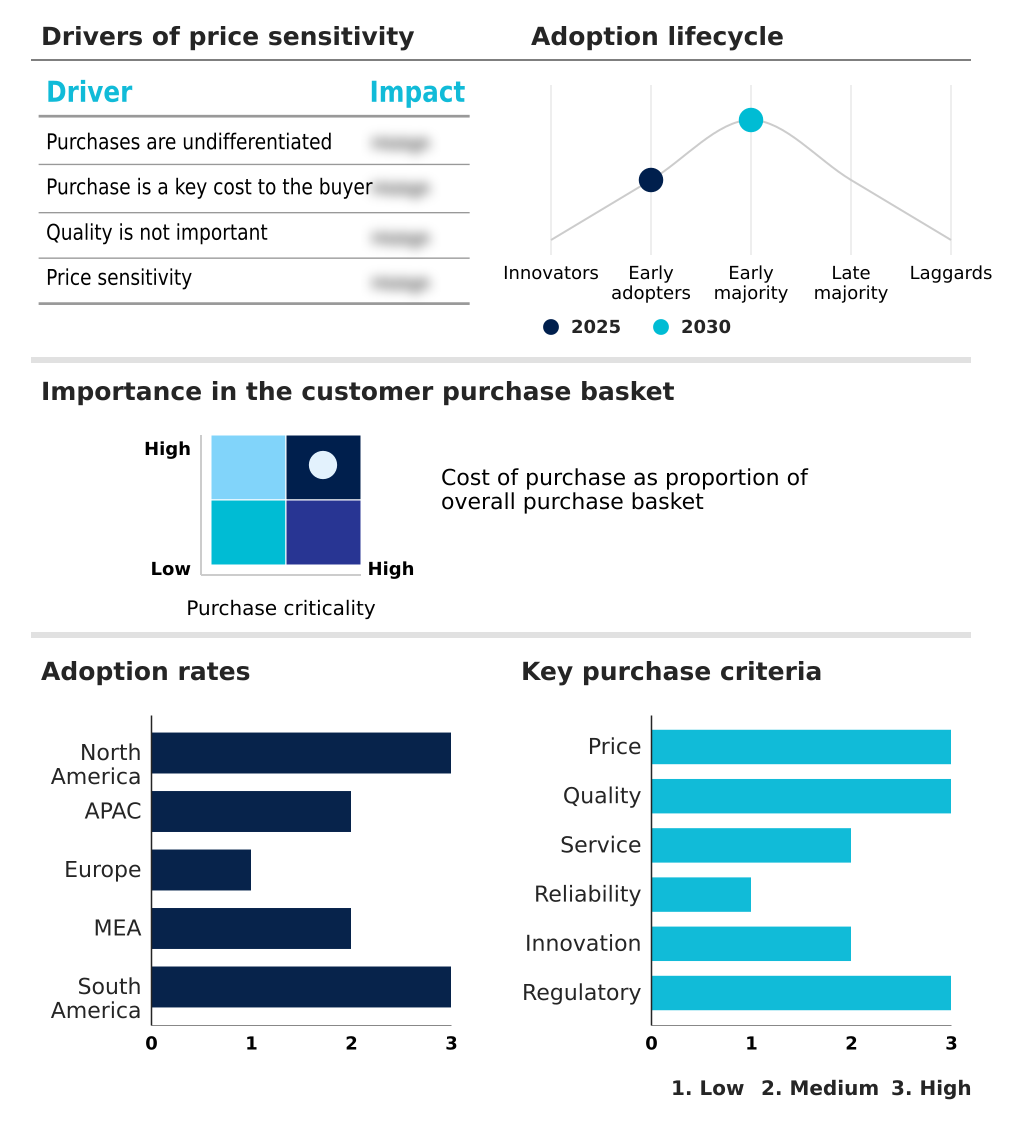
Customer Landscape of Rf Front End Integrated Circuits Industry
Competitive Landscape
Companies are implementing various strategies, such as strategic alliances, rf front end integrated circuits market forecast, partnerships, mergers and acquisitions, geographical expansion, and product/service launches, to enhance their presence in the industry.
Analog Devices Inc. - Advanced radio frequency modules, acoustic filters, and antenna tuners are provided to optimize fast switching speeds and low power consumption for digital and analog mixed-signal applications.
The industry research and growth report includes detailed analyses of the competitive landscape of the market and information about key companies, including:
- Analog Devices Inc.
- Broadcom Inc.
- Infineon Technologies AG
- MACOM Technology Solutions
- MaxLinear Inc.
- Microchip Technology Inc.
- Mitsubishi Electric Corp.
- Murata Manufacturing Co. Ltd.
- NXP Semiconductors NV
- ON Semiconductor Corp.
- Qorvo Inc.
- Qualcomm Inc.
- Renesas Electronics Corp.
- ROHM Co. Ltd.
- Silicon Laboratories Inc.
- Skyworks Solutions Inc.
- STMicroelectronics NV
- TDK Corp.
- Texas Instruments Inc.
- Vanchip Technologies Co. Ltd.
Qualitative and quantitative analysis of companies has been conducted to help clients understand the wider business environment as well as the strengths and weaknesses of key industry players. Data is qualitatively analyzed to categorize companies as pure play, category-focused, industry-focused, and diversified; it is quantitatively analyzed to categorize companies as dominant, leading, strong, tentative, and weak.
Recent Development and News in Rf front end integrated circuits market
- In the Semiconductors industry, the rapid deployment of open radio access networks has standardized modular hardware architectures, directly impacting RF Front End Integrated Circuits demand by accelerating the need for interoperable multi-band transceivers.
- The transition toward silicon carbide and advanced compound wafer fabrication processes has reduced thermal bottlenecks in high-power base stations, directly impacting RF Front End Integrated Circuits demand by enabling denser component integration.
- Global regulatory mandates for vehicle-to-everything communication safety protocols have increased automotive semiconductor content, directly impacting RF Front End Integrated Circuits demand by requiring fail-safe ultra-low latency signaling components in passenger vehicles.
- The structural shift toward automated assembly and testing of millimeter-wave components has decreased production defect rates by 12%, directly impacting RF Front End Integrated Circuits demand by lowering the final cost of high-frequency consumer modules.
Dive into Technavio’s robust research methodology, blending expert interviews, extensive data synthesis, and validated models for unparalleled Rf Front End Integrated Circuits Market insights. See full methodology.
| Market Scope | |
|---|---|
| Page number | 321 |
| Base year | 2025 |
| Historic period | 2020-2024 |
| Forecast period | 2026-2030 |
| Growth momentum & CAGR | Accelerate at a CAGR of 7.2% |
| Market growth 2026-2030 | USD 9700.1 million |
| Market structure | Fragmented |
| YoY growth 2025-2026(%) | 6.5% |
| Key countries | US, Canada, Mexico, China, Japan, South Korea, Taiwan, India, Australia, Germany, UK, France, Italy, The Netherlands, Spain, Saudi Arabia, UAE, Israel, South Africa, Turkey, Brazil, Argentina and Chile |
| Competitive landscape | Leading Companies, Market Positioning of Companies, Competitive Strategies, and Industry Risks |
Research Analyst Overview
- The RF Front End Integrated Circuits sector is experiencing a profound architectural shift toward integrated modularity, moving away from decentralized discrete components. This transition forces enterprise executives to reevaluate hardware procurement strategies, directly linking component sourcing to strict energy compliance and thermal management budgeting.
- By adopting advanced envelope tracking systems alongside sophisticated digital pre-distortion algorithms, hardware developers can dynamically regulate power consumption during peak data loads. Firms implementing these integrated phase shifter modules achieve a 30% reduction in overall system latency compared to older decentralized configurations.
- This operational efficiency is particularly vital for industrial facilities deploying narrowband-IoT protocols, where reliable low noise amplification dictates the success of automated remote monitoring. The utilization of specialized organic substrate materials further mitigates electromagnetic interference, ensuring pristine signal integrity in congested wireless environments.
- Consequently, boardroom decisions regarding technology adoption now prioritize holistic system-in-package architectures that simultaneously reduce manufacturing complexity and align with stringent international spectrum emission standards, securing long-term operational resilience.
What are the Key Data Covered in this Rf Front End Integrated Circuits Market Research and Growth Report?
-
What is the expected growth of the Rf Front End Integrated Circuits Market between 2026 and 2030?
-
USD 9.70 billion, at a CAGR of 7.2%
-
-
What segmentation does the market report cover?
-
The report is segmented by Component (Low noise amplifiers, Power amplifiers, RF filters, RF switches, and Others), Type (Sub-6 GHz, Mid frequency, and High frequency), Application (Consumer electronics, Wireless communication, Automotive, Aerospace and defense, and Others) and Geography (North America, APAC, Europe, Middle East and Africa, South America)
-
-
Which regions are analyzed in the report?
-
North America, APAC, Europe, Middle East and Africa and South America
-
-
What are the key growth drivers and market challenges?
-
Evolution of 5G advanced architectures and spectrum diversification, Increasing architectural complexity and thermal dissipation constraints in multiband systems
-
-
Who are the major players in the Rf Front End Integrated Circuits Market?
-
Analog Devices Inc., Broadcom Inc., Infineon Technologies AG, MACOM Technology Solutions, MaxLinear Inc., Microchip Technology Inc., Mitsubishi Electric Corp., Murata Manufacturing Co. Ltd., NXP Semiconductors NV, ON Semiconductor Corp., Qorvo Inc., Qualcomm Inc., Renesas Electronics Corp., ROHM Co. Ltd., Silicon Laboratories Inc., Skyworks Solutions Inc., STMicroelectronics NV, TDK Corp., Texas Instruments Inc. and Vanchip Technologies Co. Ltd.
-
Market Research Insights
- The RF Front End Integrated Circuits sector dictates the foundational performance of modern wireless hardware. By optimizing signal routing and amplification, these components are critical for achieving high-speed data transmission across dense cellular network infrastructure.
- Implementing advanced wafer-level chip-scale packaging has allowed device manufacturers to reduce internal board footprint by 25%, enabling the inclusion of larger power cells for battery longevity optimization. Furthermore, upgrading legacy discrete components to unified front-end modules yields a 40% improvement in signal-to-noise ratio during active data sessions.
- These systemic efficiency gains directly lower the total cost of ownership for telecommunication operators, reducing base station energy expenditures while ensuring seamless connectivity for enterprise applications.
We can help! Our analysts can customize this rf front end integrated circuits market research report to meet your requirements.
 RIA -