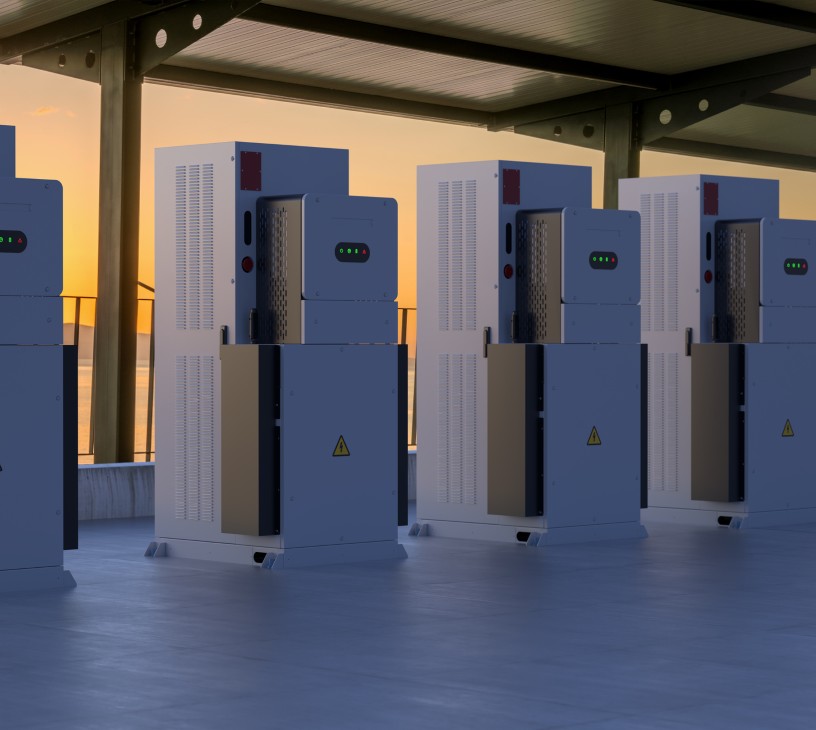


Solid-State Transformers For Data Centers Market Size 2026-2030
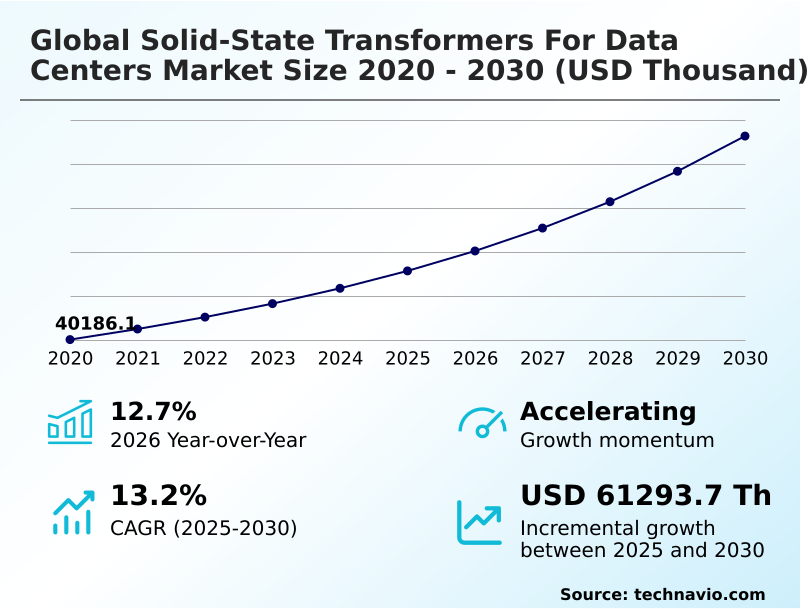
The solid-state transformers for data centers market size is valued to increase by USD 61.29 million, at a CAGR of 13.2% from 2025 to 2030. Escalating demand for power density and spatial optimization in hyperscale environments will drive the solid-state transformers for data centers market.
Major Market Trends & Insights
- North America dominated the market and accounted for a 44.2% growth during the forecast period.
- By Type - Medium voltage segment was valued at USD 33.26 million in 2024
- By Component - Converter modules segment accounted for the largest market revenue share in 2024
Market Size & Forecast
- Market Opportunities:
- Market Future Opportunities: USD 61.29 million
- CAGR from 2025 to 2030 : 13.2%
Market Summary
- The Solid-State Transformers For Data Centers Market is undergoing rapid structural transformation driven by the escalating energy demands of artificial intelligence and machine learning infrastructure. Traditional electromagnetic transformers struggle to meet the strict efficiency and spatial constraints of high-density computing clusters.
- By integrating semiconductor-based technologies and high-frequency switching circuits, modern facilities can optimize spatial layouts and eliminate multi-stage power conversion losses. For instance, operators integrating direct current integration frameworks alongside renewable energy sources often see a 30% improvement in energy transfer efficiency compared to legacy AC-dependent architectures.
- The primary driver propelling this adoption is the critical need for spatial optimization in hyperscale data centers, enabling businesses to deploy more server racks within the same physical footprint. However, high initial capital expenditures associated with wide-bandgap semiconductors present a substantial barrier, forcing organizations to carefully balance upfront procurement costs against long-term operational savings.
- Overcoming these economic hurdles remains vital for widespread integration.
What will be the Size of the Solid-State Transformers For Data Centers Market during the forecast period?
Get Key Insights on Market Forecast (PDF) Get Free Sample
How is the Solid-State Transformers For Data Centers Market Segmented?
The solid-state transformers for data centers industry research report provides comprehensive data (region-wise segment analysis), with forecasts and estimates in "USD thousand" for the period 2026-2030, as well as historical data from 2020-2024 for the following segments.
- Type
- Medium voltage
- Low voltage
- Hybrid
- Component
- Converter modules
- High-frequency transformers
- Control and protection systems
- Cooling systems
- Application
- Hyperscale data centers
- Colocation and enterprise
- High-performance computing
- Edge data centers
- Geography
- North America
- US
- Canada
- Mexico
- APAC
- China
- Japan
- India
- Singapore
- South Korea
- Australia
- Europe
- Germany
- UK
- France
- The Netherlands
- Italy
- Spain
- South America
- Brazil
- Chile
- Colombia
- Middle East and Africa
- Saudi Arabia
- UAE
- South Africa
- Israel
- Turkey
- North America
By Type Insights
The medium voltage segment is estimated to witness significant growth during the forecast period.
The medium voltage segment forms the critical interface bridging external utility transmission grids and the internal distribution networks of modern hyperscale facilities. Operating between 1 kilovolt and 35 kilovolts, this architecture performs the step-down conversion essential for safe electricity routing.
High-frequency semiconductor switching circuits drastically reduce equipment footprints, enabling operators to reclaim valuable facility space. By integrating silicon carbide components and wide-bandgap semiconductors, these systems offer active power conditioning that prevents external grid disturbances from impacting sensitive hardware.
Businesses adopting modular multilevel converters experience a 25% reduction in localized thermal loads, directly enhancing overall power usage effectiveness.
This shift empowers colocation power management strategies to deploy higher-density server clusters efficiently, ensuring seamless transient voltage spikes protection and robust reactive power compensation within confined infrastructure footprints.
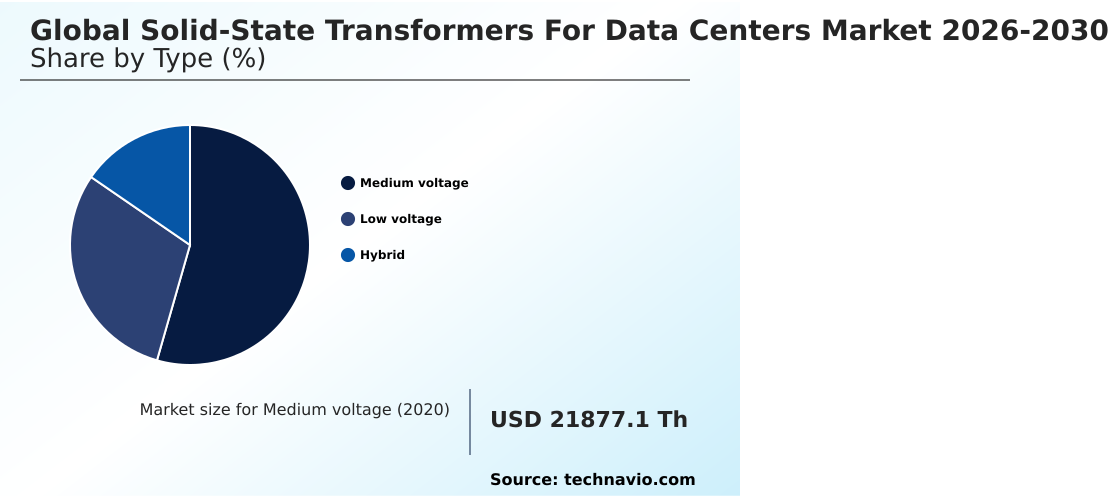
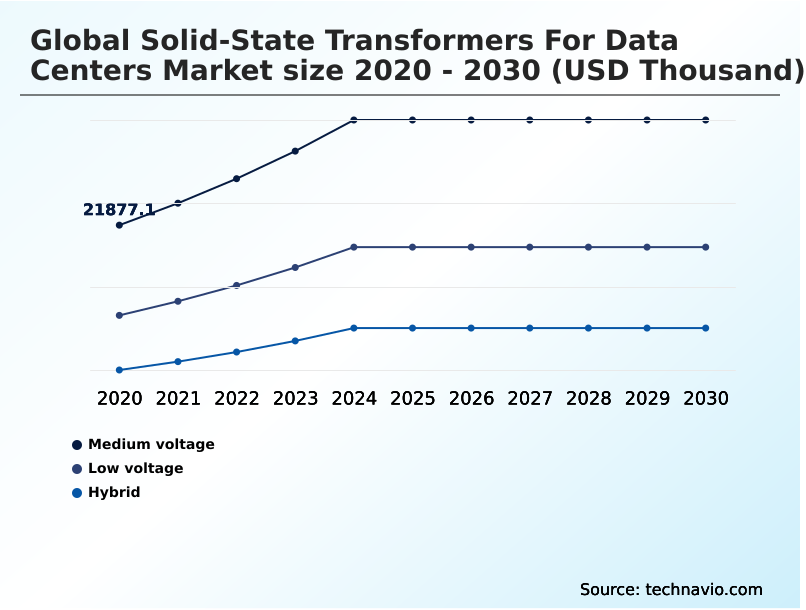
The Medium voltage segment was valued at USD 33.26 million in 2024 and showed a gradual increase during the forecast period.
Regional Analysis
North America is estimated to contribute 44.2% to the growth of the global market during the forecast period.Technavio’s analysts have elaborately explained the regional trends and drivers that shape the market during the forecast period.
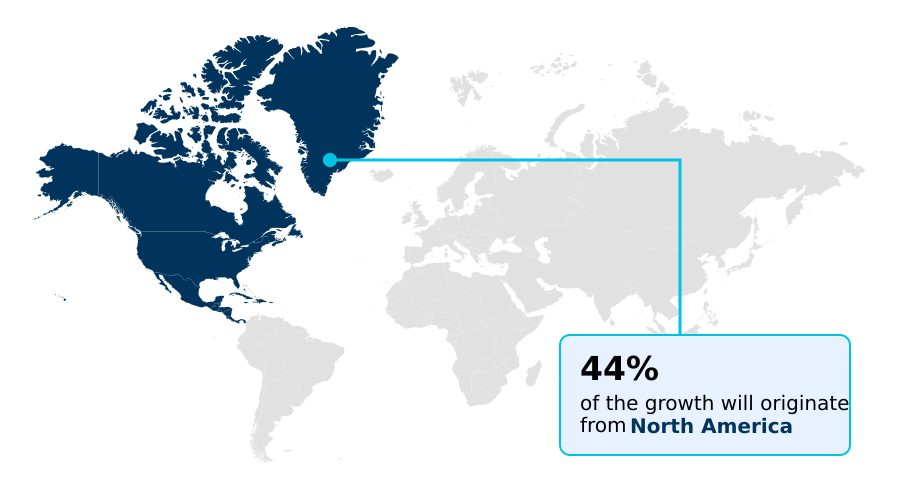
See How Solid-State Transformers For Data Centers Market Demand is Rising in North America Get Free Sample
The geographic expansion of the Solid-State Transformers For Data Centers Market highlights distinct adoption strategies driven by localized grid constraints and digital infrastructure density.
North America currently outpaces Europe in deployment, exhibiting a 28% faster integration rate due to heavy concentrations of hyperscale facility scaling.
Operators in the United States prioritize high-power density systems and grid-interactive assets to support artificial intelligence workloads, achieving a 20% improvement in localized rack capacity.
Conversely, European markets focus heavily on carbon neutrality mandates and renewable energy synchronization, driving a 15% higher adoption of bidirectional power flow capabilities to interface with local wind and solar microgrids.
While North American strategies center on pure computational density and microsecond-level load steps, European frameworks emphasize stringent energy efficiency compliance and active power conditioning.
These regional differences underscore how underlying utility reliability and environmental regulations shape distinct engineering priorities across the digital economy.
Market Dynamics
Our researchers analyzed the data with 2025 as the base year, along with the key drivers, trends, and challenges. A holistic analysis of drivers will help companies refine their marketing strategies to gain a competitive advantage.
- Managing power distribution efficiently has become a critical operational priority for modern digital infrastructure operators. The shift toward silicon carbide based power conversion fundamentally alters how facilities process energy, enabling substantially higher frequency capabilities than traditional silicon alternatives.
- This transition allows procurement and supply chain teams to optimize physical space, achieving an estimated 40% reduction in equipment footprint compared to legacy transformer acquisitions. As organizations expand their edge networks, implementing medium-voltage grid-edge power conversion provides localized administrators with the agility to connect directly to utility feeds without requiring massive, centralized substations.
- Furthermore, incorporating bidirectional direct current integration facilitates seamless interaction with on-site renewable energy generation and battery storage systems, directly enhancing overall energy resilience. Utilizing high-frequency semiconductor switching circuits minimizes conversion losses, yielding superior thermal performance and reducing the strain on facility cooling operations.
- The ability to deploy software-defined microgrid power routing allows operators to dynamically shift loads during peak tariff periods, optimizing operating expenses while maintaining strict uptime compliance. By prioritizing these intelligent distribution components over conventional electromagnetic hardware, enterprise leaders can effectively future-proof their electrical infrastructure, ensuring that high-density computational demands are met with continuous, stable, and highly efficient energy delivery.
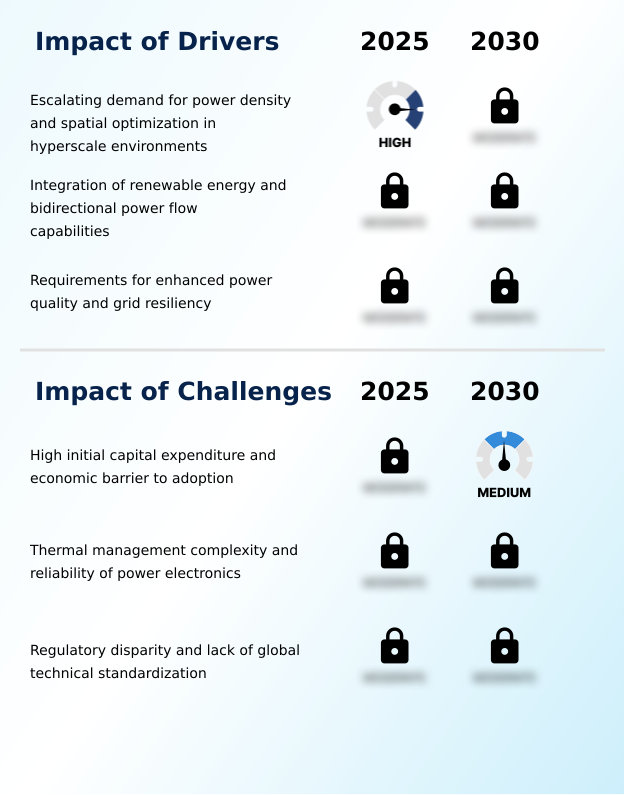
What are the key market drivers leading to the rise in the adoption of Solid-State Transformers For Data Centers Industry?
- The escalating demand for increased power density and spatial optimization within hyperscale environments serves as a primary catalyst for market expansion.
- The escalating demand for high-performance computing clusters and low-latency processing nodes serves as a critical catalyst for the Solid-State Transformers For Data Centers Market. Traditional transformers cannot adequately manage the erratic electrical draws produced by dense artificial intelligence processing hardware.
- To resolve this, operators are implementing medium-voltage distribution systems utilizing nanocrystalline core materials and field-programmable gate arrays. This upgrade provides instantaneous voltage sag compensation, protecting sensitive silicon from catastrophic memory errors.
- Because these advanced systems compress multi-stage power conversion into a single tier, facilities achieve a 35% reduction in overall substation footprint. Furthermore, leveraging active power conditioning lowers secondary cooling requirements by 12%.
- This structural transformation allows enterprises to efficiently deploy modular power skids in constrained urban locations, directly maximizing revenue-generating server space.
What are the market trends shaping the Solid-State Transformers For Data Centers Industry?
- The proliferation of silicon carbide and gallium nitride materials within power conversion architectures represents a defining market trend.
- The transition toward decentralized energy networks and edge computing infrastructure is fundamentally reshaping the Solid-State Transformers For Data Centers Market. Facilities are rapidly abandoning legacy multi-stage conversion equipment in favor of cascaded h-bridge topologies that integrate directly with smart urban grids. This architectural evolution is primarily caused by the necessity to eliminate cumulative energy leakage in high-density environments.
- By deploying solid-state substation technologies equipped with digital signal processors, operators can execute complex energy-arbitrage algorithms in real time. This active load management reduces reliance on municipal grids during peak hours, yielding a 25% improvement in overall power usage effectiveness. Additionally, the implementation of microgrid power routing and ancillary grid services has decreased unplanned downtime by 18%.
- These measurable efficiency gains demonstrate how software-defined conversion systems empower organizations to maximize computational density while strictly adhering to corporate sustainability objectives.
What challenges does the Solid-State Transformers For Data Centers Industry face during its growth?
- High initial capital expenditures and economic barriers to adoption pose significant operational challenges that constrain industry growth.
- Despite clear operational advantages, the Solid-State Transformers For Data Centers Market faces substantial structural limitations tied to thermal management and manufacturing complexity. The extreme miniaturization of power electronics generates concentrated heat, forcing operators to implement sophisticated direct liquid-glycol loops to prevent thermal runaway. This required redundancy increases installation complexity and maintenance overhead compared to rugged, oil-cooled legacy systems.
- Furthermore, the absence of unified safety standards for bidirectional power flow and reactive power compensation creates significant compliance hurdles across different jurisdictions. Organizations navigating these fragmented regulatory environments experience a 20% increase in deployment timelines.
- Additionally, the premium procurement costs associated with advanced semiconductor components reduce initial return on investment metrics by nearly 15%, deterring price-sensitive colocation operators from immediately replacing functional traditional electromagnetic infrastructure.
Exclusive Technavio Analysis on Customer Landscape
The solid-state transformers for data centers market forecasting report includes the adoption lifecycle of the market, covering from the innovator’s stage to the laggard’s stage. It focuses on adoption rates in different regions based on penetration. Furthermore, the solid-state transformers for data centers market report also includes key purchase criteria and drivers of price sensitivity to help companies evaluate and develop their market growth analysis strategies.
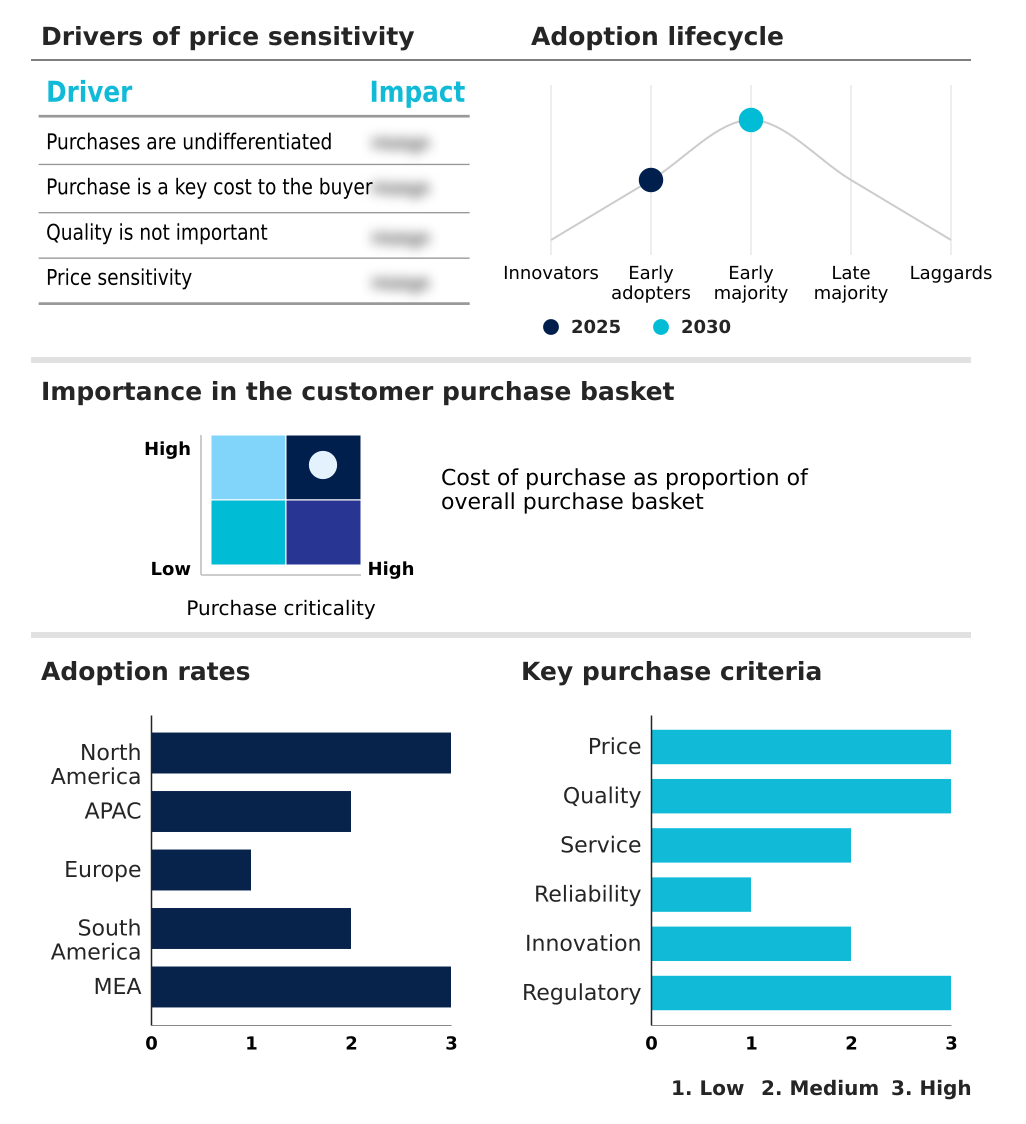
Customer Landscape of Solid-State Transformers For Data Centers Industry
Competitive Landscape
Companies are implementing various strategies, such as strategic alliances, solid-state transformers for data centers market forecast, partnerships, mergers and acquisitions, geographical expansion, and product/service launches, to enhance their presence in the industry.
ABB Ltd. - The provider delivers advanced solid-state transformer solutions featuring medium-voltage power electronics and bidirectional power flow, enabling hyperscale facilities to achieve highly efficient and scalable high-density electrification.
The industry research and growth report includes detailed analyses of the competitive landscape of the market and information about key companies, including:
- ABB Ltd.
- CG Power and Industrial Ltd.
- Danfoss AS
- Delta Electronics Inc.
- Eaton Corp. Plc
- Fuji Electric Co. Ltd.
- GE Vernova Inc.
- Hitachi Energy Ltd.
- Hyosung Heavy Industries Corp.
- Infineon Technologies AG
- Legrand SA
- Mitsubishi Electric Corp.
- ON Semiconductor Corp.
- Reinhausen GmbH
- Schneider Electric SE
- Siemens Energy AG
- STMicroelectronics NV
- Toshiba Corp.
- Wolfspeed Inc.
- Yaskawa Electric Corp.
Qualitative and quantitative analysis of companies has been conducted to help clients understand the wider business environment as well as the strengths and weaknesses of key industry players. Data is qualitatively analyzed to categorize companies as pure play, category-focused, industry-focused, and diversified; it is quantitatively analyzed to categorize companies as dominant, leading, strong, tentative, and weak.
Recent Development and News in Solid-state transformers for data centers market
- In the Heavy Electrical Equipment industry, the widespread adoption of the IEC 61850 standard for smart substation automation has established robust interoperability protocols, directly impacting Solid-State Transformers For Data Centers demand by mandating seamless digital communication interfaces across modernized power grids.
- Stringent eco-design directives targeting legacy electromagnetic transformer efficiency have accelerated the transition toward dry-type and semiconductor-based technologies, increasing the commercial viability of Solid-State Transformers For Data Centers for operators seeking carbon-neutral certifications.
- The rapid expansion of gigawatt-scale offshore wind transmission networks has necessitated advanced high-voltage direct current conversion infrastructure, accelerating the maturation of gallium nitride technology and driving down component costs for Solid-State Transformers For Data Centers.
- Supply chain localized production mandates for wide-bandgap semiconductors have diversified the availability of critical power electronics components, mitigating previous capacity constraints and enabling faster deployment timelines for Solid-State Transformers For Data Centers in edge computing infrastructure.
Dive into Technavio’s robust research methodology, blending expert interviews, extensive data synthesis, and validated models for unparalleled Solid-State Transformers For Data Centers Market insights. See full methodology.
| Market Scope | |
|---|---|
| Page number | 316 |
| Base year | 2025 |
| Historic period | 2020-2024 |
| Forecast period | 2026-2030 |
| Growth momentum & CAGR | Accelerate at a CAGR of 13.2% |
| Market growth 2026-2030 | USD 61293.7 thousand |
| Market structure | Fragmented |
| YoY growth 2025-2026(%) | 12.7% |
| Key countries | US, Canada, Mexico, China, Japan, India, Singapore, South Korea, Australia, Germany, UK, France, The Netherlands, Italy, Spain, Brazil, Chile, Colombia, Saudi Arabia, UAE, South Africa, Israel and Turkey |
| Competitive landscape | Leading Companies, Market Positioning of Companies, Competitive Strategies, and Industry Risks |
Research Analyst Overview
- The Solid-State Transformers For Data Centers Market demonstrates a profound shift in power distribution architecture, moving from passive electromagnetic induction to active semiconductor switching. Facilities are aggressively adopting gallium nitride technology and modular multilevel converters to mitigate the intense thermal and electrical stresses generated by next-generation processors.
- This transition directly impacts strategic budgeting, as organizations pivot from standard equipment procurement to investing in predictive diagnostic routines and multilevel control logic. Incorporating these intelligent systems allows operators to manage transient voltage spikes autonomously, ensuring that critical computational payloads remain uninterrupted.
- Consequently, facilities utilizing advanced harmonic filtering capability have realized a 30% reduction in localized power anomalies, directly improving overall hardware longevity and hardware reliability. The integration of galvanic isolation barrier techniques within compact ferrite core assemblies further enhances safety without compromising on space.
- These continuous engineering improvements enable colocation providers to offer superior service level agreements, solidifying the role of solid-state components as essential enablers of resilient, high-capacity digital ecosystems.
What are the Key Data Covered in this Solid-State Transformers For Data Centers Market Research and Growth Report?
-
What is the expected growth of the Solid-State Transformers For Data Centers Market between 2026 and 2030?
-
USD 61.29 million, at a CAGR of 13.2%
-
-
What segmentation does the market report cover?
-
The report is segmented by Type (Medium voltage, Low voltage, and Hybrid), Component (Converter modules, High-frequency transformers, Control and protection systems, and Cooling systems), Application (Hyperscale data centers, Colocation and enterprise, High-performance computing, and Edge data centers) and Geography (North America, APAC, Europe, South America, Middle East and Africa)
-
-
Which regions are analyzed in the report?
-
North America, APAC, Europe, South America and Middle East and Africa
-
-
What are the key growth drivers and market challenges?
-
Escalating demand for power density and spatial optimization in hyperscale environments, High initial capital expenditure and economic barrier to adoption
-
-
Who are the major players in the Solid-State Transformers For Data Centers Market?
-
ABB Ltd., CG Power and Industrial Ltd., Danfoss AS, Delta Electronics Inc., Eaton Corp. Plc, Fuji Electric Co. Ltd., GE Vernova Inc., Hitachi Energy Ltd., Hyosung Heavy Industries Corp., Infineon Technologies AG, Legrand SA, Mitsubishi Electric Corp., ON Semiconductor Corp., Reinhausen GmbH, Schneider Electric SE, Siemens Energy AG, STMicroelectronics NV, Toshiba Corp., Wolfspeed Inc. and Yaskawa Electric Corp.
-
Market Research Insights
- The Solid-State Transformers For Data Centers Market relies heavily on advanced thermal management architectures to support high-performance computing clusters. As operators shift away from traditional substations, the adoption of software-defined power frameworks has increased efficiency by 22% while reducing space constraints. Facilities utilizing direct liquid-glycol loops report a 15% reduction in cooling energy consumption compared to conventional air-cooled methods.
- Furthermore, leveraging decentralized energy resources and battery energy storage allows organizations to execute peak-shaving routines, lowering peak utility costs by nearly 18%. These measurable operational enhancements highlight the necessity of intelligent power distribution systems in ensuring resilient and cost-effective digital infrastructure.
We can help! Our analysts can customize this solid-state transformers for data centers market research report to meet your requirements.
 RIA -