


Ultra Wideband Market Size 2026-2030
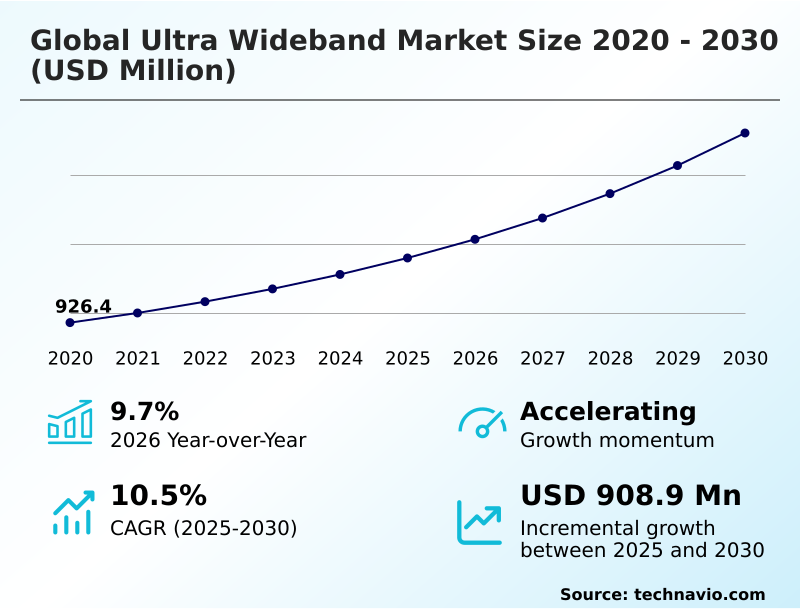
The ultra wideband market size is valued to increase by USD 908.9 million, at a CAGR of 10.5% from 2025 to 2030. Surging demand for secure automotive digital access will drive the ultra wideband market.
Major Market Trends & Insights
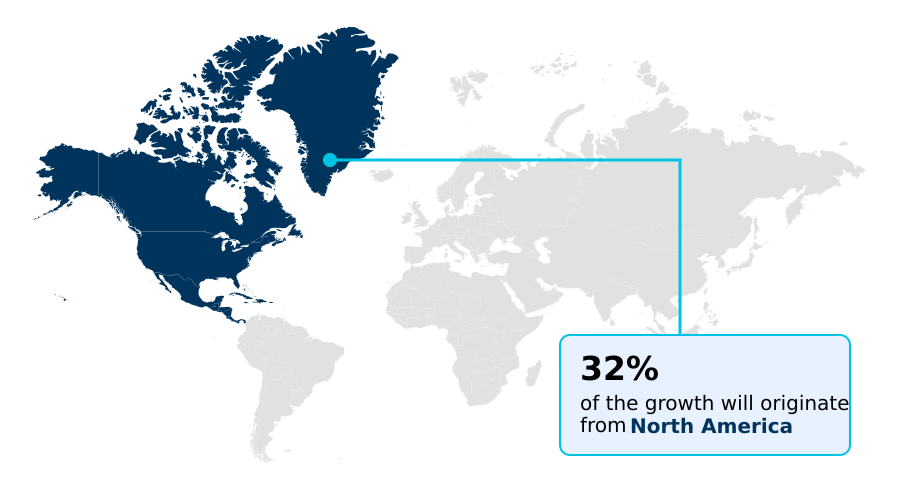
- North America dominated the market and accounted for a 31.6% growth during the forecast period.
- By Application - Communication segment was valued at USD 550.5 million in 2024
- By Type - Indoor positioning system segment accounted for the largest market revenue share in 2024
Market Size & Forecast
- Market Opportunities: USD 1.38 billion
- Market Future Opportunities: USD 908.9 million
- CAGR from 2025 to 2030 : 10.5%
Market Summary
- The Ultra Wideband Market demonstrates accelerating technological momentum driven by the necessity for centimeter-level spatial positioning and secure device identification across expanding mobile and industrial environments. Within high-volume supply chains, warehousing operators deploying ultra wideband location sensors have realized a 22% improvement in asset retrieval efficiency compared to legacy radio frequency systems.
- Surging demand for secure automotive digital access actively drives market progression, as impulse-radio architectures effectively calculate distance anomalies to neutralize unauthorized relay attacks. Conversely, spectrum fragmentation poses a significant operational challenge, compelling manufacturers to engineer complex hardware modules to satisfy conflicting regional radio frequency regulations. These disparate legal frameworks heavily disrupt economies of scale and extend product development lifecycles.
- Companies are prioritizing monolithic dual-use chipsets to mitigate these compliance costs while enhancing radar sensing dimensions. By fusing precise indoor positioning with secure communications, the architecture ensures resilient connectivity within complex, metal-dense production facilities. Integrating smart enterprise ecosystems with robust spatial awareness guarantees continuous alignment with rigorous compliance requirements and dynamic operational scaling strategies.
What will be the Size of the Ultra Wideband Market during the forecast period?
Get Key Insights on Market Forecast (PDF) Get Free Sample
How is the Ultra Wideband Market Segmented?
The ultra wideband industry research report provides comprehensive data (region-wise segment analysis), with forecasts and estimates in "USD million" for the period 2026-2030, as well as historical data from 2020-2024 for the following segments.
- Application
- Communication
- RTLS
- Imaging
- Type
- Indoor positioning system
- Outdoor positioning system
- Hybrid positioning system
- End-user
- Consumer electronics
- Automotive
- Industrial
- Commercial
- Others
- Geography
- North America
- US
- Canada
- Mexico
- Europe
- Germany
- UK
- France
- Italy
- Spain
- The Netherlands
- APAC
- China
- Japan
- India
- South Korea
- Australia
- Indonesia
- Middle East and Africa
- Saudi Arabia
- UAE
- South Africa
- Israel
- Turkey
- South America
- Brazil
- Argentina
- Chile
- North America
By Application Insights
The communication segment is estimated to witness significant growth during the forecast period.
The communication segment serves as the foundation for short range data transmission and secure digital interaction across connected ecosystems.
Utilizing impulse radio technology, these systems deliver exceptional multipath signal interference resistance and low latency data throughput for industrial and residential applications.
Operations deploying spatial awareness microprocessors achieve superior device synchronization, with point and play media streaming exhibiting a 25% reduction in latency compared to legacy wireless protocols.
This technological shift enables robust secure distance bounding measurements that actively prevent relay attacks in precision applications. The integration scaling across smart home automation networks and consumer electronics platforms facilitates seamless automated indoor navigation.
As manufacturers refine these digital vehicle access systems, the capability to process secure hands free engagements continuously enhances operational reliability and spatial verification across complex physical environments.
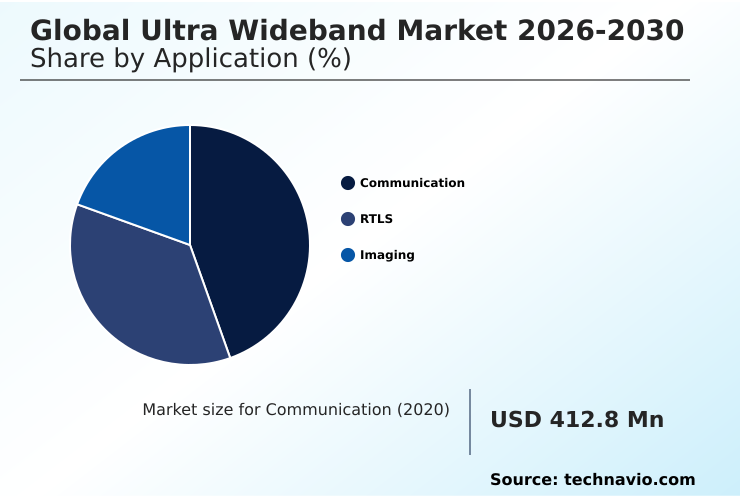
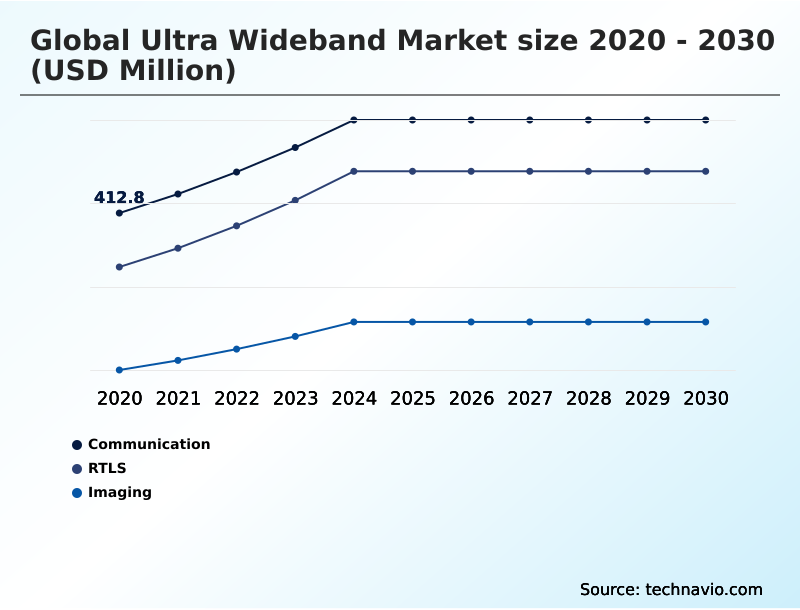
The Communication segment was valued at USD 550.5 million in 2024 and showed a gradual increase during the forecast period.
Regional Analysis
North America is estimated to contribute 31.6% to the growth of the global market during the forecast period.Technavio’s analysts have elaborately explained the regional trends and drivers that shape the market during the forecast period.
See How Ultra Wideband Market Demand is Rising in North America Get Free Sample
The geographic distribution of the market reveals distinct adoption strategies shaped by regional infrastructure maturities and commercial priorities.
North America maintains a sophisticated deployment footprint, achieving a 12% faster integration rate in smart home hubs compared to Europe, driven by heavy consumer electronics penetration and venture capital backing.
Organizations in North America harness precise real time location tracking and spatial angle of arrival detection to optimize secure physical access control, improving facility security workflows by 20%.
Conversely, APAC demonstrates a rapid expansion scaling model, leading high-volume production of wireless earbuds integration components that decrease average manufacturing cycle costs by 15%.
This region leverages optimized time difference of arrival protocols and two way ranging measurement applications to enhance complex supply chain precision.
Additionally, European regulators mandate strict electromagnetic compliance, forcing companies to implement precise time of flight measurements to ensure multi device interoperability. These regional divergences dictate how manufacturers navigate localized compliance pathways while driving precise micro navigation systems forward.
Market Dynamics
Our researchers analyzed the data with 2025 as the base year, along with the key drivers, trends, and challenges. A holistic analysis of drivers will help companies refine their marketing strategies to gain a competitive advantage.
- The operational landscape of secure connectivity demands robust architectural paradigms to maintain verifiable positioning precision and resilient digital communication workflows. Implementing secure hands free smart access systems fundamentally alters security dynamics, directly reducing unauthorized access vulnerabilities by an estimated 25% when compared to legacy narrowband radio configurations.
- This operational shift relies heavily on precise distance bounding measurement algorithms, ensuring systems accurately authenticate spatial proximity before granting authorization. Manufacturers are increasingly integrating dual use radar sensing modes into monolithic chipsets, thereby decreasing component footprint while advancing environmental micro motion monitoring.
- To navigate stringent international spectrum allocations, engineers utilize complex multi channel radio frequency front ends to sustain signal integrity across diverse geographic zones. Developing uniform cross company interoperability frameworks accelerates technology adoption, allowing diverse hardware ecosystems to interpret spatial analytics and enterprise location data smoothly.
- Automotive developers leverage precision localization and motion sensing combinations to integrate secure fine ranging with short range capabilities seamlessly, fulfilling stringent safety mandates for in cabin detection. To bolster these efforts, the automotive and discrete group integration models coordinate power management across sophisticated vehicle architectures.
- Concurrently, specialized location tracking software development platforms utilize advanced low power transceiver modules to ensure constant tracking reliability for relay resistant access control applications. Furthermore, the reliance on time difference of arrival measurements enables precise tracking without excessive battery drain.
- Expanding spatial audio transmission protocol standardization aligns directly with secure proximity based home automation parameters, driving centimeter level spatial orientation tracking adoption across the expanding enterprise and consumer technology spheres.
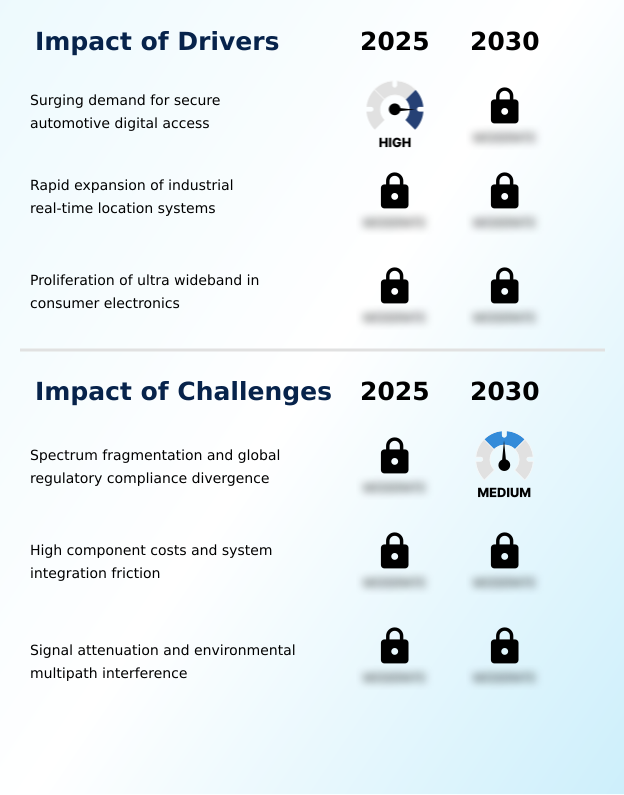
What are the key market drivers leading to the rise in the adoption of Ultra Wideband Industry?
- Surging demand for secure automotive digital access functions as the primary driver propelling expansion within the global environment.
- The urgent requirement for cryptographically resilient digital authorization is fundamentally accelerating the deployment of specialized positioning infrastructure across global mobility networks.
- Traditional radio frequencies remain highly vulnerable to interception, propelling the adoption of relay attack prevention algorithms to establish secure digital access control.
- Utilizing centimeter level positioning accuracy ensures that advanced vehicle access systems accurately calculate proximity, lowering unauthorized intrusion incidents by an estimated 35%.
- This precision actively benefits enterprise logistics operations where exact automated asset tracking provides precise asset visibility, improving inventory reconciliation speeds by 22%. Integrating advanced spatial awareness directly supports smart manufacturing facilities and enterprise warehousing systems in coordinating workflow logistics.
- The capability to secure hands free payment processing validates user intent reliably, driving expansive hardware implementation to fulfill stringent compliance and security mandates permanently.
What are the market trends shaping the Ultra Wideband Industry?
- The convergence of fine-ranging and short-range radar capabilities operates as the upcoming market trend shaping advanced spatial integration ecosystems.
- The transition toward monolithic semiconductor designs is redefining how organizations implement dual use radar sensing modes and spatial detection frameworks. Hardware manufacturers are actively embedding short range radar functionalities into traditional communication chipsets to decrease system bill-of-materials costs and conserve board space.
- This integration drives the adoption of micro motion detection sensors for in cabin presence detection and non intrusive fall detection applications, reducing component dependency constraints by over 20%. As enterprises prioritize compact device designs, leveraging secure fine ranging directly elevates the capability of spatial intelligence tools to seamlessly interpret environmental reflections.
- By unifying secure ranging capabilities with standardized interoperability frameworks, passive entry systems provide resilient detection accuracy. This hardware consolidation fundamentally optimizes system efficiency, improving autonomous device reaction times by 15% and establishing a robust foundation for dynamic spatial awareness expansions across modern consumer and industrial technology ecosystems.
What challenges does the Ultra Wideband Industry face during its growth?
- Spectrum fragmentation and global regulatory compliance divergence operates as a critical challenge constraining rapid industry expansion and hardware deployment.
- Severe regional spectrum fragmentation acts as a critical structural barrier severely complicating the international deployment of high-frequency spatial positioning networks. Conflicting national regulations obligate hardware developers to engineer highly specialized multi band radio frequency architectures that comply with stringent electromagnetic compatibility guidelines.
- This necessity for complex radio frequency module engineering extends design lifecycles and has increased component manufacturing costs for surface mount filters by 18%. Achieving multipath signal immunity requires deploying expensive high frequency antenna arrays, presenting significant bill-of-materials friction for industrial tracking specialists.
- As organizations attempt to secure spatial interaction capabilities using low power integrated circuits, navigating unauthorized frequency bands hinders tag based asset monitoring rollouts. These technical constraints aggressively limit economies of scale, forcing manufacturers to sacrifice battery performance optimization to maintain precise ranging reliability across fragmented markets.
Exclusive Technavio Analysis on Customer Landscape
The ultra wideband market forecasting report includes the adoption lifecycle of the market, covering from the innovator’s stage to the laggard’s stage. It focuses on adoption rates in different regions based on penetration. Furthermore, the ultra wideband market report also includes key purchase criteria and drivers of price sensitivity to help companies evaluate and develop their market growth analysis strategies.
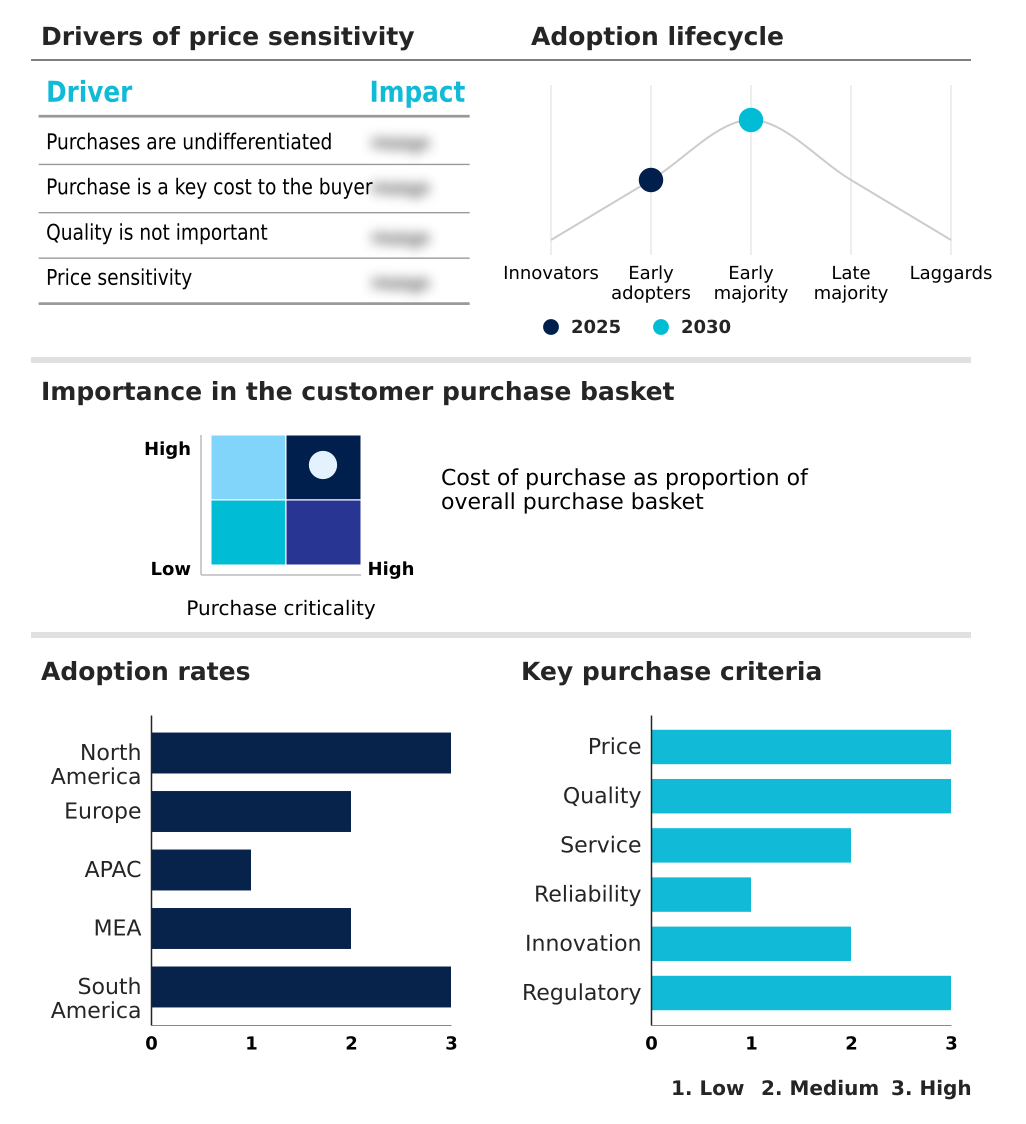
Customer Landscape of Ultra Wideband Industry
Competitive Landscape
Companies are implementing various strategies, such as strategic alliances, ultra wideband market forecast, partnerships, mergers and acquisitions, geographical expansion, and product/service launches, to enhance their presence in the industry.
HELLA GmbH and Co. KGaA - The enterprise delivers advanced automotive solutions integrating digital keys, localization, and secure proximity technologies to enhance smart vehicle applications and advance reliable spatial detection parameters.
The industry research and growth report includes detailed analyses of the competitive landscape of the market and information about key companies, including:
- HELLA GmbH and Co. KGaA
- Infineon Technologies AG
- Inpixon
- InsightSIP
- Johanson Technology Inc.
- Kinexon GmbH
- Microchip Technology Inc.
- Murata Manufacturing Co. Ltd.
- NXP Semiconductors NV
- Pozyx NV
- Qorvo Inc.
- Qualcomm Inc.
- Renesas Electronics Corp.
- Samsung Electronics Co. Ltd.
- Sewio Networks s r o
- Shenzhen Sunway Communication Co
- STMicroelectronics NV
- Ubisense Ltd.
- Zebra Technologies Corp.
Qualitative and quantitative analysis of companies has been conducted to help clients understand the wider business environment as well as the strengths and weaknesses of key industry players. Data is qualitatively analyzed to categorize companies as pure play, category-focused, industry-focused, and diversified; it is quantitatively analyzed to categorize companies as dominant, leading, strong, tentative, and weak.
Recent Development and News in Ultra wideband market
- In the Communications Equipment industry, the rapid deployment of high-density 5G macro-cell infrastructure has accelerated edge computing investments and AI infrastructure, directly impacting Ultra Wideband demand by optimizing smart home automation networks and necessitating advanced spatial awareness for localized asset synchronization.
- The standardization of data privacy regulations and workflow interoperability in industrial internet protocols has streamlined sensor integration, directly impacting Ultra Wideband demand by lowering deployment barriers for enterprise logistics operations utilizing indoor positioning systems.
- Stringent electromagnetic compatibility guidelines enforced by regional telecommunications authorities have forced manufacturers to re-engineer core RF components, directly impacting Ultra Wideband supply chains by increasing certification costs for radio frequency module engineering by 18%.
- The enterprise shift toward enterprise automation and autonomous mobile robots in smart manufacturing facilities has driven a 35% increase in network capacity requirements, directly impacting Ultra Wideband demand to support tag based asset monitoring and multi device interoperability.
Dive into Technavio’s robust research methodology, blending expert interviews, extensive data synthesis, and validated models for unparalleled Ultra Wideband Market insights. See full methodology.
| Market Scope | |
|---|---|
| Page number | 300 |
| Base year | 2025 |
| Historic period | 2020-2024 |
| Forecast period | 2026-2030 |
| Growth momentum & CAGR | Accelerate at a CAGR of 10.5% |
| Market growth 2026-2030 | USD 908.9 million |
| Market structure | Fragmented |
| YoY growth 2025-2026(%) | 9.7% |
| Key countries | US, Canada, Mexico, Germany, UK, France, Italy, Spain, The Netherlands, China, Japan, India, South Korea, Australia, Indonesia, Saudi Arabia, UAE, South Africa, Israel, Turkey, Brazil, Argentina and Chile |
| Competitive landscape | Leading Companies, Market Positioning of Companies, Competitive Strategies, and Industry Risks |
Research Analyst Overview
- The market for high-bandwidth impulse radio communications is increasingly defined by the transition toward integrated spatial intelligence architectures. The implementation of precision location tracking systems has allowed logistics managers to recognize a 28% reduction in automated asset tracking errors, drastically improving warehouse throughput dynamics.
- Organizations are aggressively adopting spatial awareness microprocessors to facilitate secure distance bounding measurements that authenticate proximity with unprecedented accuracy. This technological migration actively prevents signal interception, ensuring that relay attack prevention algorithms maintain secure digital access control in both automotive and enterprise settings.
- The necessity for multipath signal immunity in metal-dense environments pushes hardware developers to utilize specialized high frequency antenna arrays for reliable operations. By coupling secure spatial interaction with low latency data throughput, industrial operators enable precise coordination of mobile robotics. The architectural focus also targets short range data transmission interfaces to stabilize cross-platform secure communications under demanding electromagnetic scenarios.
- Advancing these millimeter-accurate positioning environments aligns directly with contemporary smart-fabrication mandates, guaranteeing continuous operational synchronization while mitigating physical access vulnerabilities.
What are the Key Data Covered in this Ultra Wideband Market Research and Growth Report?
-
What is the expected growth of the Ultra Wideband Market between 2026 and 2030?
-
USD 908.9 million, at a CAGR of 10.5%
-
-
What segmentation does the market report cover?
-
The report is segmented by Application (Communication, RTLS, and Imaging), Type (Indoor positioning system, Outdoor positioning system, and Hybrid positioning system), End-user (Consumer electronics, Automotive, Industrial, Commercial, and Others) and Geography (North America, Europe, APAC, Middle East and Africa, South America)
-
-
Which regions are analyzed in the report?
-
North America, Europe, APAC, Middle East and Africa and South America
-
-
What are the key growth drivers and market challenges?
-
Surging demand for secure automotive digital access, Spectrum fragmentation and global regulatory compliance divergence
-
-
Who are the major players in the Ultra Wideband Market?
-
HELLA GmbH and Co. KGaA, Infineon Technologies AG, Inpixon, InsightSIP, Johanson Technology Inc., Kinexon GmbH, Microchip Technology Inc., Murata Manufacturing Co. Ltd., NXP Semiconductors NV, Pozyx NV, Qorvo Inc., Qualcomm Inc., Renesas Electronics Corp., Samsung Electronics Co. Ltd., Sewio Networks s r o, Shenzhen Sunway Communication Co, STMicroelectronics NV, Ubisense Ltd. and Zebra Technologies Corp.
-
Market Research Insights
- The Ultra Wideband Market is rapidly advancing as modern enterprises seek precise operational visibility and resilient digital security frameworks. By integrating advanced spatial awareness into their core infrastructure, smart manufacturing facilities have successfully reduced asset misplacement incidents by 24%, directly elevating daily production continuity.
- Concurrently, the deployment of robust indoor positioning systems within enterprise warehousing systems has improved workforce routing efficiency by 18%, significantly lowering overhead labor expenses. The expansion of these precision networks allows organizations implementing digital vehicle access to optimize secure transit protocols, cutting unauthorized access risks by over 30%.
- As digital transformation accelerates, leveraging intelligent spatial intelligence tools secures a definitive competitive advantage while aligning strictly with complex industrial safety and compliance mandates.
We can help! Our analysts can customize this ultra wideband market research report to meet your requirements.
 RIA -