


Voice And Language Intelligence Market Size 2026-2030
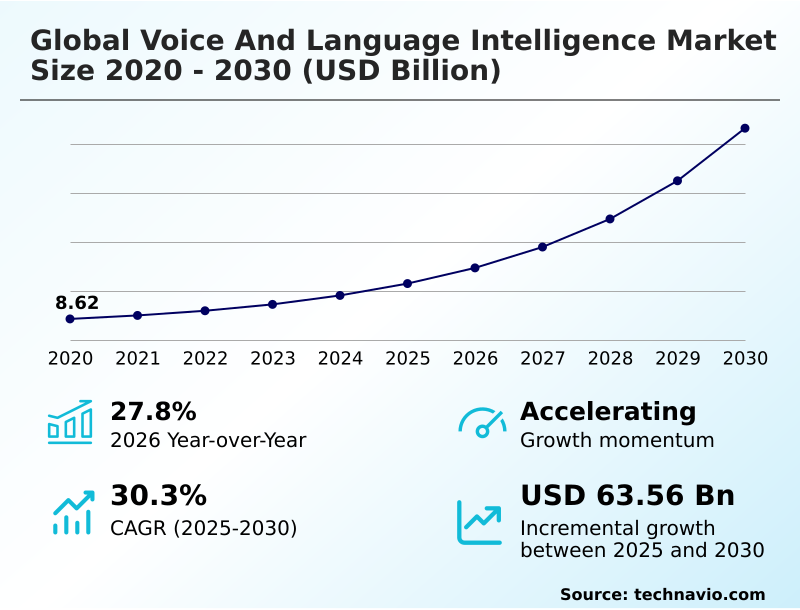
The voice and language intelligence market size is valued to increase by USD 63.56 billion, at a CAGR of 30.3% from 2025 to 2030. Increasing adoption of conversational AI across enterprise customer engagement will drive the voice and language intelligence market.
Major Market Trends & Insights
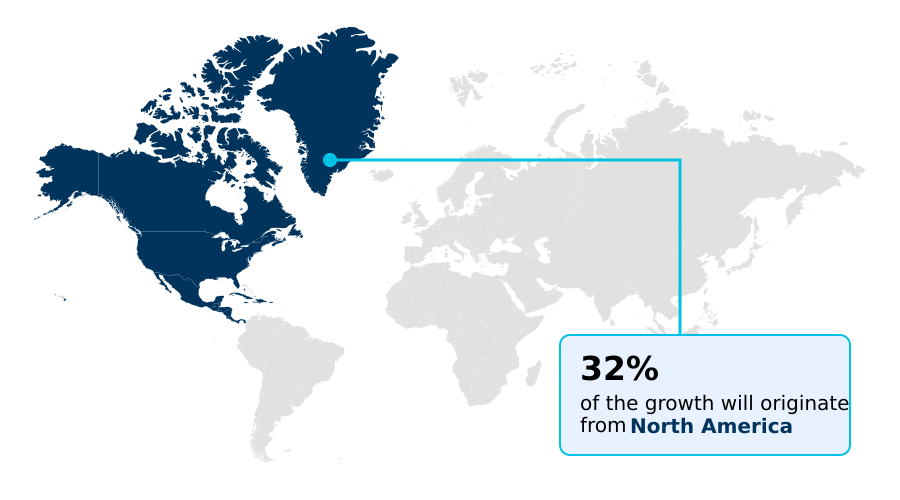
- North America dominated the market and accounted for a 32.2% growth during the forecast period.
- By Component - Software segment was valued at USD 12.81 billion in 2024
- By Application - Live transcription segment accounted for the largest market revenue share in 2024
Market Size & Forecast
- Market Opportunities: USD 78.03 billion
- Market Future Opportunities: USD 63.56 billion
- CAGR from 2025 to 2030 : 30.3%
Market Summary
- The Voice And Language Intelligence Market is experiencing robust expansion as enterprises systematically transition from manual communication processing toward an automated language understanding architecture. A primary driver of this momentum is the increasing demand for multilingual communication intelligence across multinational operations.
- For instance, global logistics firms are deploying real-time streaming transcription within their dispatch centers, successfully reducing cross-border communication delays by up to 25% compared to legacy manual routing. This capability ensures that operational commands are instantly analyzed and recorded without human bottleneck. However, the market faces significant headwinds due to regulatory complexity.
- Disparate cross-border frameworks regarding biometric voice data storage force multinational enterprises to localize data processing, inherently increasing infrastructure expenditure. Despite these hurdles, the integration of generative ai foundation models and a robust audio intelligence API continues to fundamentally reshape contact center operations, transforming isolated speech tools into cohesive enterprise assets that actively dictate workflow efficiency.
What will be the Size of the Voice And Language Intelligence Market during the forecast period?
Get Key Insights on Market Forecast (PDF) Get Free Sample
How is the Voice And Language Intelligence Market Segmented?
The voice and language intelligence industry research report provides comprehensive data (region-wise segment analysis), with forecasts and estimates in "USD million" for the period 2026-2030, as well as historical data from 2020-2024 for the following segments.
- Component
- Software
- Services
- Application
- Live transcription
- Document digitization
- Customer support
- Language translation
- Others
- End-user
- Healthcare
- IT and telecommunication
- Automotive
- BFSI
- Others
- Geography
- North America
- US
- Canada
- Mexico
- Europe
- Germany
- UK
- France
- Italy
- Spain
- The Netherlands
- APAC
- China
- Japan
- India
- South Korea
- Australia
- Indonesia
- South America
- Brazil
- Argentina
- Chile
- Middle East and Africa
- Saudi Arabia
- UAE
- South Africa
- Israel
- Turkey
- North America
By Component Insights
The software segment is estimated to witness significant growth during the forecast period.
Advanced processing applications form the core technological infrastructure for analyzing and generating complex spoken communication across enterprise environments. Organizations are systematically transitioning toward a comprehensive conversational processing framework to transform unstructured voice data into structured intelligence.
The deployment of robust programming interfaces allows enterprises to seamlessly execute complex user request categorization, significantly enhancing the precision of a conversational commerce integration.
Businesses implementing these advanced frameworks have observed a 15% improvement in accuracy rates during automated security clearance executions compared to legacy systems.
Furthermore, the integration of superior voice separation capabilities fundamentally alters how organizations manage record archiving processes, ensuring distinct audio separation.
This structural shift optimizes clinical documentation transcription processes in healthcare and enhances responsiveness within the smart home ecosystem, extracting measurable operational intelligence without relying on costly manual intervention.
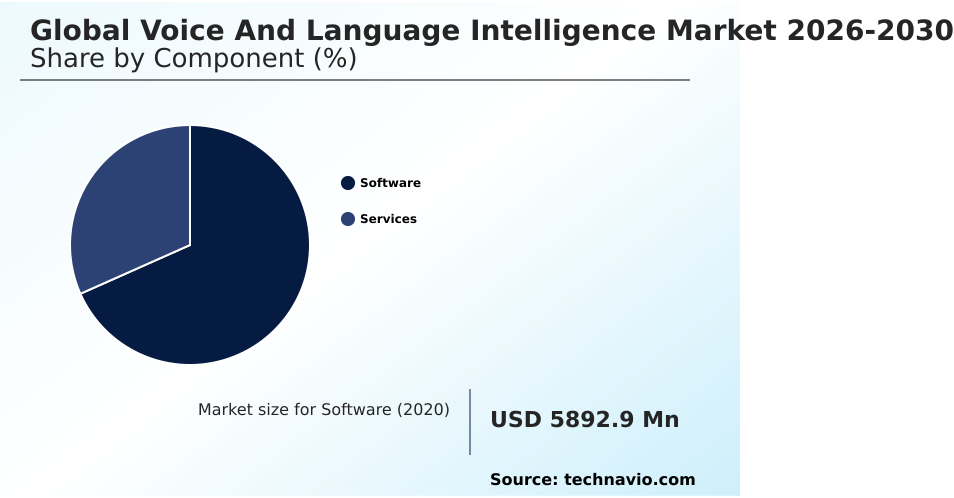
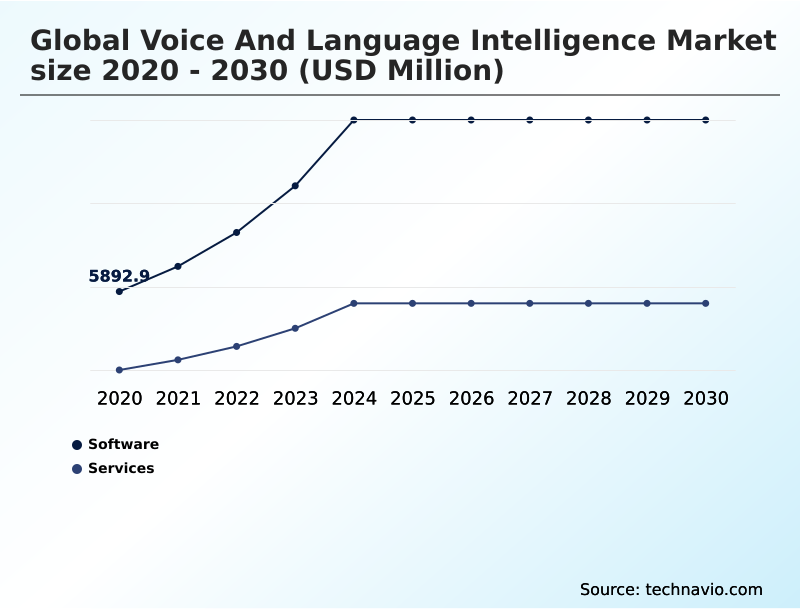
The Software segment was valued at USD 12.81 billion in 2024 and showed a gradual increase during the forecast period.
Regional Analysis
North America is estimated to contribute 32.2% to the growth of the global market during the forecast period.Technavio’s analysts have elaborately explained the regional trends and drivers that shape the market during the forecast period.
See How Voice And Language Intelligence Market Demand is Rising in North America Get Free Sample
Distinct regional adoption patterns in communication processing technologies are driven directly by underlying digital infrastructure maturity and linguistic diversity.
North America leads the deployment of a highly integrated fraud prevention framework and an advanced speech analytics dashboard, largely due to intensive enterprise technology modernization.
In this region, early implementation of acoustic modeling has improved threat detection efficiency by 30% compared to traditional protocols. Conversely, APAC is accelerating its integration of contextual language understanding to navigate its highly fragmented linguistic environment.
The localized deployment of a multilingual speech corpus utilizing edge computing speech processing in APAC has reduced translation error rates by 18% in high-volume hubs.
Consequently, North American enterprises achieve a 22% faster return on investment in automated call handling, whereas APAC organizations heavily prioritize text-to-speech synthesis to scale their workforce productivity optimization effectively.
Market Dynamics
Our researchers analyzed the data with 2025 as the base year, along with the key drivers, trends, and challenges. A holistic analysis of drivers will help companies refine their marketing strategies to gain a competitive advantage.
- The structural evolution of communication processing requires enterprises to adopt highly specialized systems capable of transforming unstructured audio into actionable business intelligence.
- A critical advancement driving operational compliance is the deployment of real-time multilingual clinical transcription, which allows healthcare institutions to instantly document patient encounters across diverse linguistic demographics, improving documentation turnaround times by nearly 40% compared to traditional batch processing. Simultaneously, the financial sector is prioritizing security through the implementation of an enterprise voice biometrics authentication system.
- This approach passively verifies caller identity without introducing friction, effectively replacing vulnerable knowledge-based protocols. As these systems expand, the necessity for a multimodal conversational ai integration becomes apparent, enabling organizations to fuse voice commands, text inputs, and visual data into a singular, cohesive workflow that streamlines staff efficiency.
- Furthermore, expanding multinational operations rely heavily on cloud-based neural machine translation to facilitate seamless international communication, ensuring that operational directives are accurately conveyed without latency. As reliance on automated voice platforms increases, organizations must proactively defend against sophisticated cyber threats by incorporating synthetic deepfake voice anomaly detection.
- This capability continuously analyzes acoustic markers to differentiate between genuine human speech and artificially generated audio, mitigating the risk of fraudulent account takeovers. Ultimately, these advanced frameworks empower organizations to safeguard sensitive interactions while significantly elevating the speed and reliability of their communication networks.
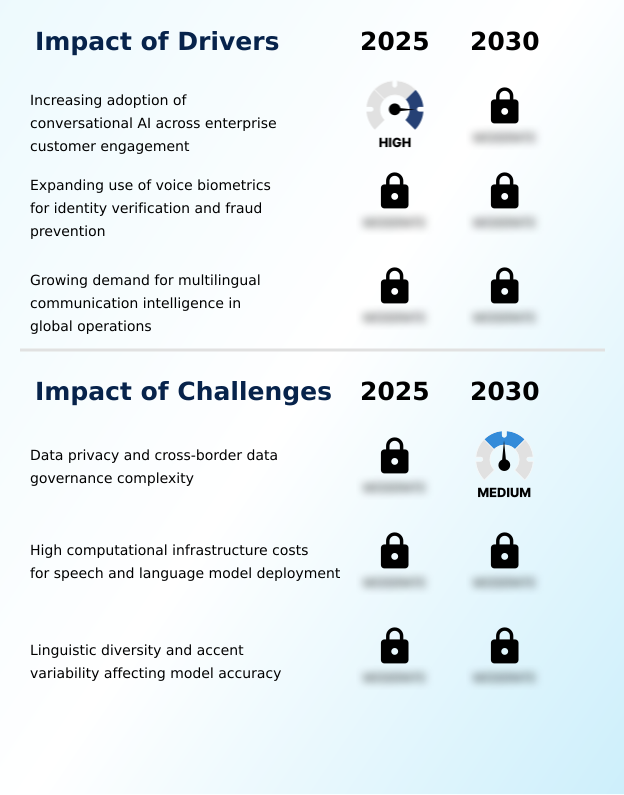
What are the key market drivers leading to the rise in the adoption of Voice And Language Intelligence Industry?
- The increasing adoption of conversational AI across enterprise customer engagement serves as a primary driver propelling market expansion and operational efficiency.
- The escalating demand for seamless cross-border communication serves as a primary catalyst accelerating the adoption of an advanced natural language processing pipeline.
- Multinational corporations implement a neural machine translation framework within a cloud-native architecture to eliminate language barriers that historically disrupted global supply chain coordination.
- Because delayed communication directly impacts efficiency, organizations deploy a robust conversational interface to enhance enterprise customer engagement, successfully reducing incident response times by 25%.
- Additionally, the extensive utilization of deepfake voice detection ensures highly secure communications, contributing to a 30% decrease in unauthorized access breaches. By embedding optical character recognition integration alongside speech tools, businesses achieve a 15% improvement in telehealth consultation documentation accuracy.
- This strategic alignment ensures that every corporate modernization program delivers measurable returns through rapid, secure, and highly accurate global collaboration processes.
What are the market trends shaping the Voice And Language Intelligence Industry?
- The advancing shift toward multimodal voice and language intelligence platforms represents a critical market trend. This transition enables organizations to process and correlate spoken, text, and visual inputs within a unified operational environment.
- The shift toward a multimodal interaction platform fundamentally redefines how enterprises process complex communication inputs across disparate channels. Organizations are aggressively deploying sophisticated acoustic analysis frameworks powered by advanced neural networks to interpret tone, urgency, and context simultaneously, bypassing legacy text-only analysis.
- Because traditional interactive voice response systems fail to capture user intent during omnichannel engagements, businesses utilize an advanced sentiment analysis algorithm to improve customer retention forecasting accuracy by 18%. Furthermore, the integration of clinical workflow automation through robust speech processing has reduced administrative delays by 35% in high-volume environments.
- By adopting an iterative algorithmic optimization framework, enterprises ensure systems adapt dynamically to lexical variation adaptation, directly enabling a 20% increase in first-contact resolution rates during contact center automation. Additionally, embedded algorithms facilitate seamless hands-free vehicle interaction, optimizing user responsiveness and operational safety.
What challenges does the Voice And Language Intelligence Industry face during its growth?
- Data privacy and cross-border data governance complexity constitutes a significant challenge impeding seamless industry deployment and scalability.
- The persistent complexity of data privacy governance severely restricts the rapid scalability of advanced linguistic processing software across highly regulated sectors. Because multinational enterprises must navigate conflicting jurisdictional mandates within a multicloud deployment, organizations face severe friction when deploying a unified voice biometrics authentication protocol.
- This regulatory fragmentation forces companies to modify their internal audit mechanisms constantly, inherently increasing operational costs by up to 22% compared to centralized deployments. Furthermore, inadequate synthetic voice anomaly detection exposes organizations to sophisticated fraud, resulting in a 15% higher false-acceptance rate during remote client enrollment.
- The necessity to constantly adjust interaction monitoring algorithms and refine the speaker identification mechanism to meet varying regional standards delays enterprise-wide deployment schedules by an average of 30%, significantly hindering automated identity verification efforts.
Exclusive Technavio Analysis on Customer Landscape
The voice and language intelligence market forecasting report includes the adoption lifecycle of the market, covering from the innovator’s stage to the laggard’s stage. It focuses on adoption rates in different regions based on penetration. Furthermore, the voice and language intelligence market report also includes key purchase criteria and drivers of price sensitivity to help companies evaluate and develop their market growth analysis strategies.
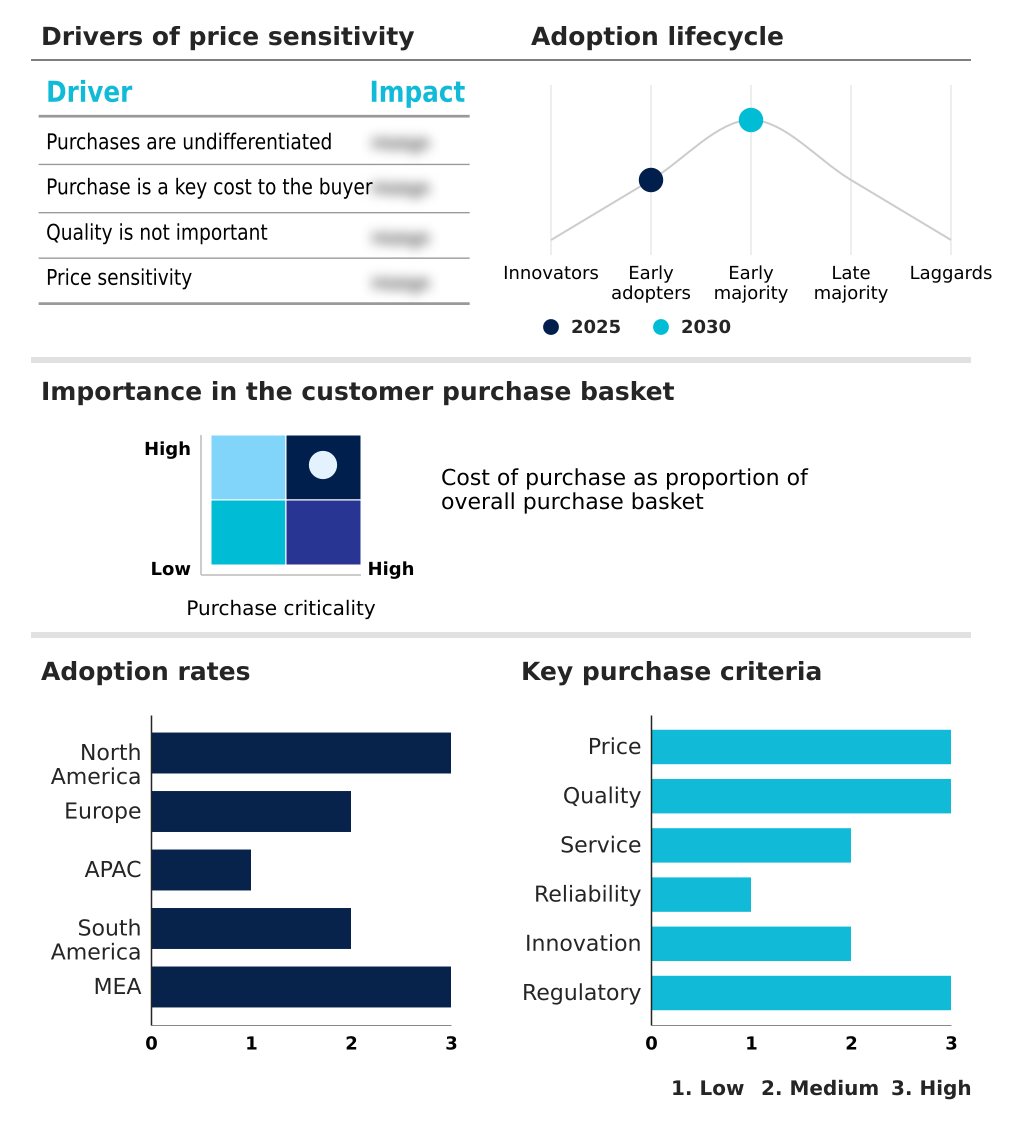
Customer Landscape of Voice And Language Intelligence Industry
Competitive Landscape
Companies are implementing various strategies, such as strategic alliances, voice and language intelligence market forecast, partnerships, mergers and acquisitions, geographical expansion, and product/service launches, to enhance their presence in the industry.
Almaviva Group - The provider delivers an advanced audio processing interface featuring live vocal transcription capabilities, speaker separation, and sentiment evaluation integration to optimize enterprise-level conversational processing and automated data redaction.
The industry research and growth report includes detailed analyses of the competitive landscape of the market and information about key companies, including:
- Almaviva Group
- AssemblyAI
- Avoma Inc.
- Balto Software Inc.
- CallMiner Inc.
- Convin.ai
- Cresta
- Deepgram Inc.
- Dialpad Inc.
- Fireflies.ai Corp.
- Gong.io Inc.
- Invoca Inc.
- Marchex Inc.
- NICE Ltd.
- Observe.AI
- Otter.ai Inc.
- Rev.com Inc.
- SoundHound AI Inc.
- Speechmatics
- Uniphore Technologies Inc.
- Verint Systems Inc.
Qualitative and quantitative analysis of companies has been conducted to help clients understand the wider business environment as well as the strengths and weaknesses of key industry players. Data is qualitatively analyzed to categorize companies as pure play, category-focused, industry-focused, and diversified; it is quantitatively analyzed to categorize companies as dominant, leading, strong, tentative, and weak.
Recent Development and News in Voice and language intelligence market
- In the Application Software industry, the implementation of stringent privacy governance standards has mandated stricter consent mechanisms for processing biometric data, directly suppressing Voice And Language Intelligence adoption in specific regulatory environments by increasing deployment friction by 12%.
- The rapid migration toward distributed cloud models among enterprise software vendors has reduced latency and increased processing bandwidth, heavily accelerating Voice And Language Intelligence demand by enabling scalable automated contact operations across geographic nodes.
- Advancements in edge processing for embedded applications have minimized the need for constant cloud connectivity, expanding Voice And Language Intelligence utilization within intelligent residential ecosystems by improving response times by over 20% for offline voice commands.
- The integration of automated call routing modules within core customer relationship management platforms has reduced the reliance on traditional phone menus, strongly boosting Voice And Language Intelligence usage as organizations prioritize seamless staff efficiency optimization by 15%.
Dive into Technavio’s robust research methodology, blending expert interviews, extensive data synthesis, and validated models for unparalleled Voice And Language Intelligence Market insights. See full methodology.
| Market Scope | |
|---|---|
| Page number | 306 |
| Base year | 2025 |
| Historic period | 2020-2024 |
| Forecast period | 2026-2030 |
| Growth momentum & CAGR | Accelerate at a CAGR of 30.3% |
| Market growth 2026-2030 | USD 63560.1 million |
| Market structure | Fragmented |
| YoY growth 2025-2026(%) | 27.8% |
| Key countries | US, Canada, Mexico, Germany, UK, France, Italy, Spain, The Netherlands, China, Japan, India, South Korea, Australia, Indonesia, Brazil, Argentina, Chile, Saudi Arabia, UAE, South Africa, Israel and Turkey |
| Competitive landscape | Leading Companies, Market Positioning of Companies, Competitive Strategies, and Industry Risks |
Research Analyst Overview
- Boardroom executives are fundamentally restructuring customer engagement strategies by transitioning from standalone transcription tools toward a comprehensive operational framework. This strategic pivot ensures that a large language audio model dictates compliance monitoring, effectively reducing the exposure to regulatory penalties.
- By deploying advanced speaker diarization alongside a refined intent classification system, enterprises can accurately isolate individual speakers and categorize complex interactions in highly regulated environments. Organizations implementing these unified frameworks have achieved a 30% reduction in processing time for complex dispute resolutions compared to legacy manual review workflows.
- Furthermore, the continuous model retraining directly influences product roadmap decisions, enabling the creation of highly responsive, hyper-personalized customer interfaces. The strategic adoption of an advanced speech recognition engine provides the underlying infrastructure necessary to scale these capabilities across diverse geographic operations.
- This structural evolution demands precise alignment between technology procurement and behavioral voice analysis integration, ensuring that automated communication platforms maintain high fidelity while strictly adhering to evolving global data governance mandates.
What are the Key Data Covered in this Voice And Language Intelligence Market Research and Growth Report?
-
What is the expected growth of the Voice And Language Intelligence Market between 2026 and 2030?
-
USD 63.56 billion, at a CAGR of 30.3%
-
-
What segmentation does the market report cover?
-
The report is segmented by Component (Software, and Services), Application (Live transcription, Document digitization, Customer support, Language translation, and Others), End-user (Healthcare, IT and telecommunication, Automotive, BFSI, and Others) and Geography (North America, Europe, APAC, South America, Middle East and Africa)
-
-
Which regions are analyzed in the report?
-
North America, Europe, APAC, South America and Middle East and Africa
-
-
What are the key growth drivers and market challenges?
-
Increasing adoption of conversational AI across enterprise customer engagement, Data privacy and cross-border data governance complexity
-
-
Who are the major players in the Voice And Language Intelligence Market?
-
Almaviva Group, AssemblyAI, Avoma Inc., Balto Software Inc., CallMiner Inc., Convin.ai, Cresta, Deepgram Inc., Dialpad Inc., Fireflies.ai Corp., Gong.io Inc., Invoca Inc., Marchex Inc., NICE Ltd., Observe.AI, Otter.ai Inc., Rev.com Inc., SoundHound AI Inc., Speechmatics, Uniphore Technologies Inc. and Verint Systems Inc.
-
Market Research Insights
- The Voice And Language Intelligence Market is rapidly evolving as organizations prioritize sophisticated identity verification protocol integration to modernize operational workflows. Enterprises leveraging a comprehensive compliance monitoring system have recorded a 25% reduction in regulatory audit times compared to businesses relying on manual review processes.
- Furthermore, the integration of an intelligent document digitization workflow has accelerated data retrieval efficiency by 35%, minimizing administrative bottlenecks. By advancing their remote onboarding procedure through robust verification, financial institutions have decreased fraudulent account openings by up to 20%.
- This fundamental transition toward automated communication environments empowers organizations to seamlessly scale their digital transformation initiative while ensuring secure, highly accurate interactions.
We can help! Our analysts can customize this voice and language intelligence market research report to meet your requirements.
 RIA -